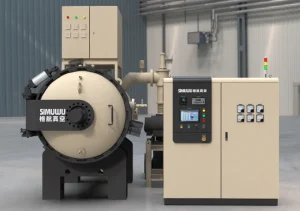
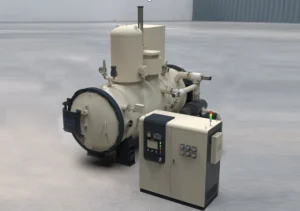
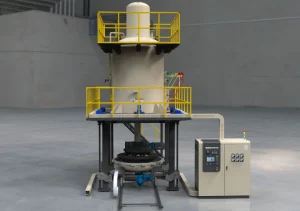
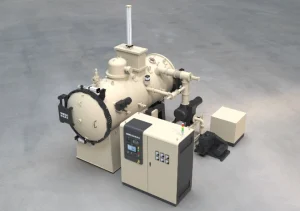
Selecting the optimal surface-hardening method is a critical decision for engineers balancing part performance with production efficiency. This vacuum vs controlled atmosphere carburizing comparison examines the fundamental differences between traditional gas carburizing and modern low-pressure carburizing (LPC) technologies. By understanding the metallurgical outcomes, environmental impacts, and technical constraints of each path, component longevity and process repeatability can be enhanced.
1. Process Fundamentals: Atmosphere vs. Vacuum
Controlled atmosphere carburizing is a legacy technology that operates at near-atmospheric pressure using a carrier gas, typically endothermic gas (CO, H2, and N2), mixed with an enriching hydrocarbon. The process relies on oxygen probes or infrared analysis to control the carbon potential, using the CO + H2 → C (in steel) + H2O reaction as the primary carbon pump. While well-established, this method involves complex gas-phase reactions that are sensitive to atmosphere fluctuations and furnace door openings.
In contrast, vacuum carburizing, often referred to as Low-Pressure Carburizing (LPC), occurs in an evacuated chamber at pressures typically below 20 mbar. The process uses pure hydrocarbons, such as acetylene (C2H2), which dissociates directly on the steel surface without the need for a carrier gas. This eliminates the “carbon pump” complexity and allows for much higher temperatures (up to 1050°C), significantly accelerating carbon diffusion rates compared to traditional vacuum heat treatment furnace operations.
2. Metallurgical Quality Comparison
2.1 Internal Oxidation and Surface Integrity
The presence of oxygen and water vapor in controlled atmosphere furnaces leads to internal oxidation (intergranular oxidation) along grain boundaries, typically reaching depths of 10–25 μm. This oxidation depletes alloying elements like Chromium, Manganese, and Silicon, which can reduce the fatigue strength of critical components like gears by up to 30%. Because vacuum carburizing operates in an oxygen-free environment, it completely eliminates internal oxidation, ensuring a pristine surface microstructure.
Surface integrity in vacuum systems is further enhanced by the absence of decarburization during the heating phase. Traditional furnaces risk surface carbon loss if the atmosphere is not perfectly balanced before the enrichment cycle begins. By utilizing a Vacuum Carburizing Furnace, manufacturers achieve a consistent hardness profile from the very surface to the core, which is vital for high-precision aerospace and automotive applications.
2.2 Case Depth Uniformity and Repeatability
Vacuum carburizing excels in treating components with complex geometries, blind holes, or dense loads because the low-pressure gas penetrates small crevices more effectively than atmospheric mixtures. In controlled atmosphere systems, gas flow “shadowing” can lead to uneven carbon distribution in recessed areas. Modern LPC systems achieve case depth repeatability of ±3%, a level of precision that is technically unattainable in batch atmosphere furnaces.
The use of high-pressure gas quenching or integrated oil quenching in a Dual-chamber Vacuum Oil Quenching Furnace further stabilizes dimensional results. Reduced thermal shock during the quenching phase minimizes heat treatment distortion in vacuum furnaces, often allowing parts to be machined to final dimensions prior to hardening, thereby reducing total manufacturing costs.
3. Productivity and Environmental Impact
Vacuum carburizing significantly reduces cycle times by allowing for higher processing temperatures and eliminating the “conditioning” time required to stabilize furnace atmospheres. The boost-diffuse method used in LPC allows for rapid carbon saturation followed by precise diffusion, which is particularly efficient for deep case requirements. Furthermore, vacuum furnaces do not require the constant flaring of exhaust gases, making them a “greener” technology with zero CO2 emissions from the process itself.
Environmental safety is another clear distinction in the vacuum vs controlled atmosphere carburizing comparison. Traditional gas carburizing involves flammable and toxic gases (CO) and requires extensive safety systems to prevent explosions. Vacuum equipment is inherently safer and can be integrated directly into a machining cell or “green” factory environment.
4. Technical Comparison Table
| Feature | Controlled Atmosphere Carburizing | Vacuum (Low Pressure) Carburizing |
|---|---|---|
| Operating Pressure | Atmospheric (~1000 mbar) | Low Pressure (1 – 20 mbar) |
| Carbon Source | Endo gas + Natural gas (CO/H2) | Pure Acetylene (C2H2) |
| Internal Oxidation | Present (10-25 μm typical) | None (Zero oxygen environment) |
| Case Depth Control | ± 10% average | ± 3% high precision |
| Temperature Range | 840°C – 950°C | 900°C – 1050°C |
| Distortion Risk | Higher (Non-uniform cooling) | Minimized (Controlled quenching) |
| Environmental Impact | CO2 emissions, high gas consumption | Eco-friendly, zero process CO2 |
5. FAQ
Q: Is vacuum carburizing suitable for mass production?
A: Yes, while initial capital investment is higher, the shorter cycle times and elimination of post-treatment cleaning make it highly cost-effective for mass-produced automotive gears and fuel injection components.
Q: Can I carburize stainless steel in a vacuum?
A: Vacuum carburizing is highly effective for specific stainless alloys, though it requires precise temperature control to prevent the formation of unwanted chromium carbides that could compromise corrosion resistance.
Q: What is the typical quench medium for vacuum carburizing?
A: Depending on the alloy and part thickness, either high-pressure gas quenching (up to 20 bar) or oil quenching is used. Oil quenching in a vacuum is often preferred for low-alloy steels to ensure full hardness.
Q: Does vacuum carburizing eliminate the need for grinding?
A: In many cases, yes. Because there is no scale or internal oxidation and distortion is minimized, many manufacturers can move from “heat treat then grind” to “finish machine then heat treat.”
The vacuum vs controlled atmosphere carburizing comparison highlights a clear industry shift toward low-pressure technology for high-performance components. While atmosphere furnaces remain viable for low-tolerance parts with minimal budget requirements, vacuum technology provides the precision, surface integrity, and environmental sustainability required for modern manufacturing standards. For in-depth metallurgical data and industry standards, refer to the technical resources at ASM International. To discuss your specific application or request a quote for a custom Vacuum Carburizing Furnace, please contact us today.
-

The Role of Nitrogen Partial Pressure in Vacuum Furnaces
2026-09-25
-
Factors Affecting the Quality of Vacuum Heat Treatment
2026-09-22
-
Application of RVGQ-557 Vacuum Gas Quenching Furnace—Gas Quenching and Tempering
2026-09-18
-
The Role and Benefits of Equipping Vacuum Furnaces with Dew Point Meters
2026-09-15
-
How to Bake Out a Vacuum Furnace After Shutdown? A Complete Restart Guide
2026-09-11