Vacuum sintering is a core process conducted within a high-vacuum environment of 10⁻³ to 10⁻⁴ Pa; it serves to eliminate pores, inhibit grain coarsening, and enhance both density (≥99%) and purity. This technique is ideally suited for high-end applications such as high-purity and transparent alumina ceramics, vacuum devices, and electrical insulators. The following sections provide a detailed explanation covering raw materials and formulation, equipment, and the sintering process.
1. Raw Materials and Formulation Design
1.1 Powder Requirements
Purity: 99.9%–99.99% α-Al₂O₃; for industrial-grade 99% alumina ceramics, a purity range of 99.0%–99.3% is acceptable.
1.2 Sintering Aids
| Formulation Systems | Ingredients (wt%) | Functions | Applicable Scenarios |
| High Purity, Additive-Free | 100% Al₂O₃ | High purity, high electrical insulation, and transparency | Transparent Ceramics, Semiconductor Vacuum Components |
| MgO Single Additive | Al₂O₃+0.5~1.0% MgO | Inhibits abnormal grain growth and lowers the sintering temperature | 99% Alumina Ceramics, Structural Components, Wear-Resistant Parts |
| Composite Additive (Low Temperature) | Al₂O₃+0.7%MgO+1.5% SiO₂+0.3%CaO | Forms a liquid phase at 1450–1550°C, promoting densification | Medium-Temperature Sintering, Low-Cost Industrial Parts |
2. Vacuum Sintering Process (99%–99.9% Al₂O₃)
- Stage 1: Vacuum Evacuation + Binder Removal (Room Temp → 600°C)
Vacuum Level: ≤ 10 Pa.
Heating Rate: 1–2°C/min (Slow binder removal to prevent cracking).
Soaking: 400°C × 2 h; 600°C × 2 h.
Objective: To remove adsorbed water and binders, preventing blistering or “black core” defects at high temperatures. - Stage 2: Intermediate-Temperature Densification (600°C → 1200°C)
Vacuum Level: 10⁻² – 10⁻³ Pa.
Heating Rate: 5–8°C/min (Accelerates diffusion and initiates preliminary densification).
No soaking; direct heating. - Stage 3: High-Temperature Sintering (1200°C → 1650–1750°C)
Vacuum Level: ≤ 5 × 10⁻⁴ Pa (High vacuum to facilitate pore elimination).
Heating Rate: 2–4°C/min (Slow rate to prevent excessive grain growth).
Soaking: 1650–1700°C × 2–3 h.
Objective: Grain growth and grain boundary fusion. - Stage 4: Cooling (1700°C → Room Temp)
Furnace Cooling under Vacuum: ≤ 5°C/min (Slow cooling above 1000°C to prevent thermal shock cracking).
Below 1000°C, high-purity Ar gas may be introduced; cooling rate ≤ 10°C/min.
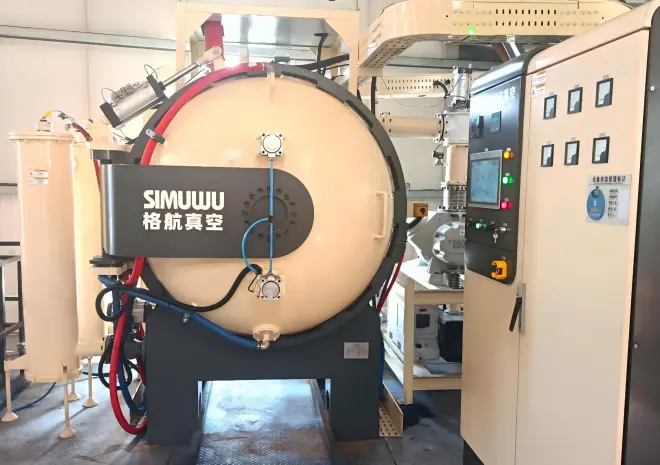
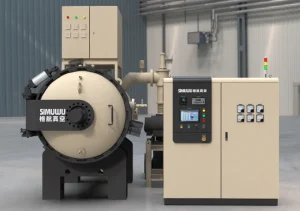
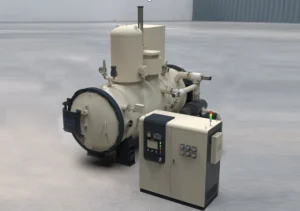
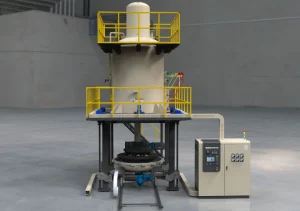
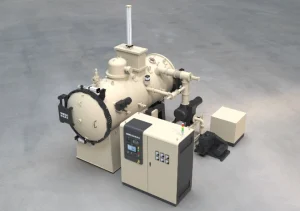
3. Vacuum Sintering Equipment
Furnace Type Selection
Key Configuration:
- • Heating Elements: Molybdenum / Graphite
- • Vacuum System: 3-stage vacuum pump system (combination of diffusion pump, Roots pump, mechanical pump, and holding pump); ultimate vacuum: 5 × 10⁻⁴ Pa.
- • Temperature Control: WRe thermocouples, 9-point temperature measurement, digital temperature controller; control accuracy: ±5°C; multi-segment programmable control.
SIMUWU specializes in the manufacturing of vacuum furnaces, boasting over a decade of relevant experience and a strong reputation within the industry. Our product line encompasses vacuum gas quenching furnaces, vacuum oil quenching furnaces, vacuum brazing furnaces, vacuum sintering furnaces, and more; these products are widely exported to both developed and developing nations.
If you require further information regarding our vacuum furnace equipment, please send your inquiries to contrect us, and we will provide you with a comprehensive and satisfactory solution.
-
Vacuum Furnace Design Considerations for High-Performance Heat Treatment
2026-05-06 -
VHeat treatment: Normalizing vs. Tempering vs. Annealing
2026-04-30 -
The Lifeline of Vacuum Aluminum Brazing Technology: Furnace Temperature Uniformity
2026-04-29 -
Vacuum Annealing for Additive Manufacturing Components
2026-04-24 -
Heat Treatment Distortion in Vacuum Furnaces vs. Other Furnaces
2026-04-23