Heat treatment is essential for achieving specific material properties in metals, yet it frequently induces various forms of distortion that threaten dimensional precision and structural integrity. The choice of furnace technology—whether vacuum, atmospheric, or salt bath—directly dictates the magnitude and nature of these deviations. This article compares microstructural, geometric, and structural distortions across different furnace environments, highlighting why heat treatment distortion in vacuum furnaces is typically the most manageable for high-precision engineering.
1. Microstructural Distortion and Surface Integrity
Microstructural distortion refers to unwanted changes in the grain structure or phase composition, often resulting from surface reactions with the furnace atmosphere. Vacuum furnaces operate in a low-pressure environment, typically between 10⁻² to 10⁻⁵ Torr, which fundamentally alters the microstructural evolution during processing.
The near-total absence of reactive gases in a vacuum effectively prevents surface oxidation, decarburization, and nitridation.
Clean processing environments result in more uniform phase transformations by reducing thermal gradients and eliminating surface degradation.
Vacuum environments facilitate the degassing of dissolved hydrogen and other impurities, which reduces the risk of voids and porosity that contribute to microstructural instability.
Research indicates that materials treated in vacuum, such as high-entropy alloys, exhibit more homogeneous microstructures with significantly reduced segregation compared to atmospheric methods.
2. Geometric Distortion and Temperature Uniformity
Geometric distortion involves the physical warping or dimensional change of a component, largely driven by non-uniform heating and cooling cycles. Precise control over heat treatment distortion in vacuum furnaces is achieved through superior temperature uniformity and sophisticated quenching controls.
Vacuum furnaces offer exceptional temperature uniformity, which minimizes the thermal gradients responsible for uneven expansion and contraction.
Studies comparing inert-gas and high-vacuum furnaces show that vacuum environments provide more stable temperature gradients across the workload.
Complex part geometries, which naturally carry a high potential for distortion, benefit from the radiation-dominant heating of vacuum furnaces that ensures more consistent energy absorption.
Poor temperature control in atmospheric furnaces often leads to non-uniform austenitization, a primary cause of subsequent geometric warping during quenching.
2.1 The Role of Quenching Media
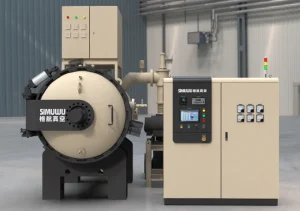
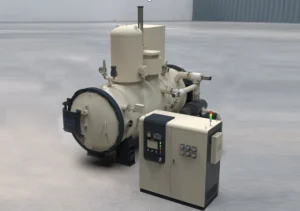
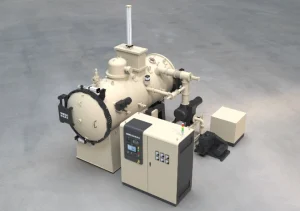
The cooling phase is the most critical stage for geometric stability, as different media extract heat at vastly different rates. Utilizing a Vacuum Gas Quenching Furnace allows for high-pressure gas cooling, which is far more uniform than liquid immersion.
Gas quenching provides a more controlled and symmetrical heat extraction compared to oil or water, reducing the “thermal shock” that causes parts to twist or bow.
Liquid quenching media, such as water or oil, create significant thermal gradients between the surface and the core, leading to greater deformation of the outer surface.
Simulations show that volume reduction and dimensional changes are more pronounced when using aggressive cooling media like water compared to air or gas.
3. Structural Distortion and Residual Stress Management
Structural distortion is characterized by internal stresses that remain within the part after it reaches thermal equilibrium. These residual stresses develop due to the competition between thermal contraction and phase transformation strains.
Non-uniform cooling creates non-uniform phase transformations, which are the leading cause of residual stress and potential quench cracking.
Vacuum furnaces allow for “stepped” or isothermal cooling profiles that balance these internal stresses more effectively than traditional batch furnaces.
While some compressive surface stresses are helpful for fatigue resistance, excessive tensile stresses can lead to immediate failure or long-term stress-corrosion cracking.
Advanced Dual-chamber Vacuum Gas Quenching Furnace designs enable rapid transfer to the quenching zone, ensuring the phase transformation occurs under optimal, controlled conditions to minimize these stresses.
4. Vacuum Furnaces vs. Traditional Alternatives
Choosing the right furnace technology requires balancing technical precision with economic factors. While atmospheric and salt bath furnaces are common, they often require extensive post-heat treatment machining to correct distortions.
Atmospheric furnaces are prone to scaling and oxidation, necessitating additional grinding or finishing steps that increase total production costs.
Salt bath furnaces offer high heat transfer rates but present environmental risks and safety concerns regarding salt disposal and part contamination.
Vacuum processing provides the most comprehensive solution for distortion control, yielding “bright” parts that often require zero post-treatment cleaning or machining.
5. FAQ
Q: What is the primary cause of distortion during heat treatment?
A: Distortion is primarily caused by non-uniform temperature distribution and the resulting uneven phase transformations within the metal. High thermal gradients lead to internal stresses that manifest as geometric warping or microstructural defects.
Q: How does a vacuum furnace reduce machining costs?
A: By preventing surface oxidation and minimizing dimensional warping, vacuum furnaces produce parts that are closer to their final “net-shape.” This reduces or eliminates the need for expensive post-heat treatment processes like hard-turning or grinding.
Q: Is gas quenching always better than oil quenching for distortion?
A: Generally, yes. Gas quenching in a vacuum environment provides a much more uniform cooling rate across the entire surface of the part, which significantly reduces the internal stresses and geometric twisting associated with the vapor-phase and boiling-phase transitions of oil quenching.
Q: Can part geometry alone cause distortion?
A: Yes. Complex geometries with varying cross-sections naturally cool at different rates. Thick sections retain heat longer than thin sections, creating internal “tugs” that lead to distortion. This is why uniform heating and cooling in a vacuum furnace is critical for complex components.
Minimizing heat treatment distortion in vacuum furnaces is a strategic advantage for manufacturers of precision components. By leveraging superior temperature uniformity and controlled quenching, vacuum technology ensures microstructural integrity and dimensional stability that atmospheric furnaces cannot match. For more detailed technical specifications on our vacuum furnaces solutions, please ontact us or Learn more about the physics of distortion.
-
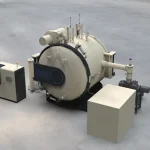
RVGQ-7710 Vacuum Gas Quenching Furnace with Top-and-Bottom Opposing Gas Flow Structure
2026-10-20
-
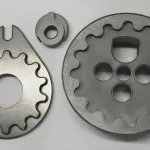
Machining of Precision Automotive Components: Application of High-Pressure Vacuum Gas Quenching
2026-10-16
-
How to Enhance the Surface Brightness of Vacuum Tempered Workpieces
2026-10-13
-
Production of High-Pressure Die-Casting Molds: Application of Vacuum Gas-Quenching Furnaces
2026-10-08
-
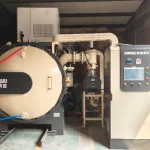
RVGQ-557 vacuum gas-quenching furnace with an air-duct structure
2026-09-30