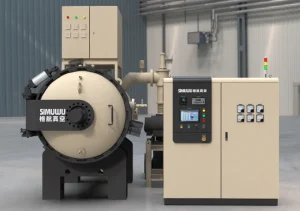
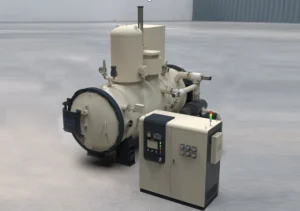
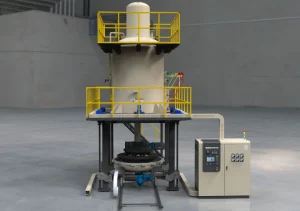
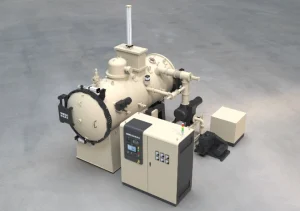
1. Role of the Vacuum Heating Chamber
The vacuum furnace heating chamber is a core component of the equipment for heat treatment processes. It provides a sealed, high-temperature vacuum environment for the workpiece, precisely controlling the heating rate and temperature uniformity to effectively prevent oxidation, decarburization, and contamination at high temperatures. This allows for various precision heat treatment processes such as degassing, annealing, quenching, and brazing. Furthermore, its excellent insulation structure reduces heat loss and improves energy efficiency, while protecting the heating elements, insulation layer, and furnace structure from workpiece volatiles and high-temperature corrosion, ensuring stable equipment operation, consistent product batch performance, and extended overall machine lifespan.
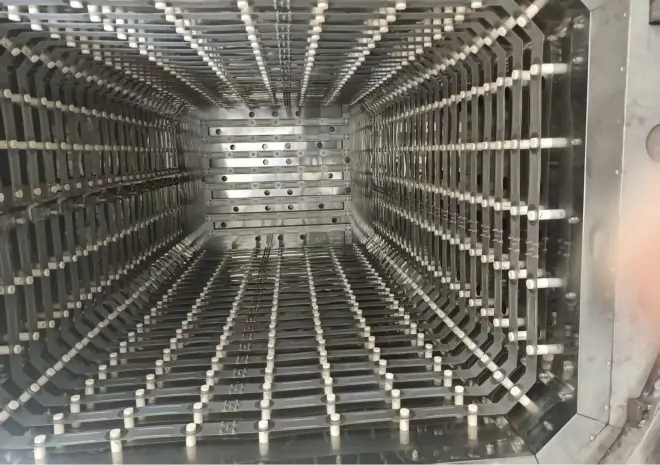
2. Types of Metal Heating Elements
The selection of heating elements is crucial. Generally, heating elements can be divided into metal heating elements and non-metal heating elements, each with its own advantages and disadvantages. Today, we will mainly introduce metal heating elements.
Metal heating elements offer advantages such as high temperature resistance, rapid heating rate, sensitive thermal response, good material toughness for easy processing and shaping, simple installation and maintenance, stable operation in a vacuum environment, uniform heating, maintaining a clean furnace environment, and ensuring bright white products. Nickel-chromium alloys and molybdenum-lanthanum alloys are the most common types.
- • Nickel-chromium alloy: Typically used in brazing furnaces with a maximum design temperature of around 800℃. These furnaces are often used in the production of automotive heat exchangers. The process temperature is stable within the suitable range for aluminum brazing. Nickel-chromium alloy heating elements have low vapor pressure and minimal outgassing under these temperatures and high vacuum conditions, making them less prone to generating volatile substances that contaminate the workpiece and furnace cavity. They possess excellent high-temperature strength and thermal stability, are not easily deformed or aged, and exhibit uniform heating and good temperature control response. They can meet the process requirements of stability, cleanliness, temperature control accuracy, and service life for mass brazing production of products such as automotive heat exchangers. Furthermore, their price is lower than that of molybdenum-lanthanum alloys and tungsten alloys, which are also metal heating elements, making them outstanding in terms of overall adaptability and economy.
- • Molybdenum-lanthanum alloy: Molybdenum-lanthanum alloys can operate at temperatures up to 1400℃, enabling high-temperature heat treatment processes for most materials. They are commonly used in vacuum quenching furnaces and titanium alloy vacuum annealing furnaces. Molybdenum-lanthanum alloys exhibit excellent high-temperature resistance, high strength, and good creep resistance. They are not prone to deformation or sagging at high temperatures, have a high recrystallization temperature, strong high-temperature structural stability, excellent electrical and thermal conductivity, a low coefficient of thermal expansion, and resistance to rapid heating and cooling. In vacuum and inert atmospheres, they have low vapor pressure, low volatilization, and are less likely to contaminate workpieces inside the furnace. They also have good machinability and are suitable for manufacturing vacuum furnace heating zones, insulation components, and high-temperature structural parts, with a long service life.
3. Metal vs. Graphite Heating Elements
Compared to graphite heating elements, which are also very common in high-temperature heat treatment, their biggest advantages are: no carbon dust is generated at high temperatures, no carbon precipitation contamination occurs, and workpieces will not be carburized, blackened, or deteriorated. The metal material has high structural strength, resistance to deformation, good dimensional stability, faster thermal response, and more precise temperature field control. Furthermore, they do not contaminate the workpiece surface in aluminum brazing and non-ferrous metal heat treatment processes, making them suitable for clean, carburized-free precision vacuum heat treatment processes. They are applicable in some high-precision industries, such as mobile phone accessories, computer accessories, and monitor accessories.
By selecting appropriate heating elements for different operating conditions in SIMUWU vacuum furnace equipment, not only can the requirements of various heat treatment and vacuum brazing processes be precisely matched, effectively ensuring uniform heating of workpieces and avoiding quality defects such as oxidation, carburization, and surface contamination, but also product quality is controlled from the source, demonstrating a high degree of responsibility for the quality of finished products. Furthermore, it enhances equipment operational stability, reduces heating element wear and the frequency of malfunctions and repairs, extends the overall service life of the equipment, reduces subsequent maintenance costs and downtime losses, and maximizes the value of customers’ equipment investment. This results in long-term stable savings in production costs and improved production efficiency
For any technical questions or requirements, please feel free to contact us. We are dedicated to serving you.
-
Factors Affecting the Quality of Vacuum Heat Treatment
2026-09-22
-
Application of RVGQ-557 Vacuum Gas Quenching Furnace—Gas Quenching and Tempering
2026-09-18
-
The Role and Benefits of Equipping Vacuum Furnaces with Dew Point Meters
2026-09-15
-
How to Bake Out a Vacuum Furnace After Shutdown? A Complete Restart Guide
2026-09-11
-
Top-and-Bottom Blast Vacuum Gas Quenching Furnace
2026-09-08