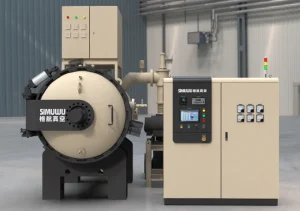
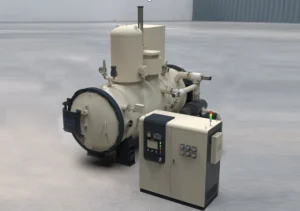
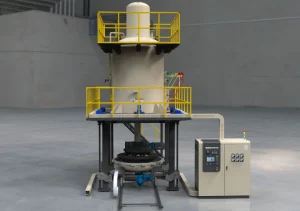
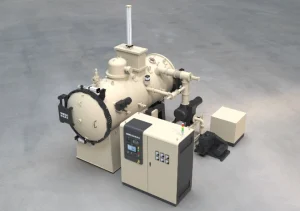
Heat treatment processes determine mechanical performance, dimensional stability, and operating noise (NVH). Components such as automotive transmission gears, aerospace planetary gears, and industrial speed reducers require high surface hardness, high contact fatigue resistance, and superior bending fatigue strength at the tooth root. Vacuum oil quenching furnaces utilizing low-pressure carburizing (LPC) resolve the metallurgical defects inherent to traditional atmosphere carburizing, providing precise process control for gear manufacturing lines.
Heat Treatment Challenges in High-Precision Gear Production
Traditional endothermic atmosphere carburizing introduces metallurgical and dimensional variations that compromise high-load gear performance:
- Intergranular Oxidation (IGO): Oxygen presence during traditional carburizing causes preferential oxidation of alloying elements (Cr, Mn, Si) at grain boundaries down to depths of 5–15 µm. This soft layer at the gear tooth root serves as a crack initiation site, reducing tooth root bending fatigue strength by 30% to 50%.
- Thermal & Microstructural Distortion: Non-uniform heating and uncontrolled carbon potential yield inconsistent martensitic transformations. Resulting dimensional distortion increases gear pitch error and lead profile variation, forcing manufacturers to leave excessive grinding allowances.
- Uneven Case Depth on Gear Geometry: Gaseous atmosphere carburizing struggles to achieve consistent carbon flux between the gear tooth tip, pitch line, and root, leading to over-carburized tooth tips and under-carburized roots.
Technical Mechanism
Vacuum oil quenching furnaces process gear workpieces under low pressure (typically 1–10 mbar) using high-temperature acetylene pulse cycles.
1. High-Penetration Carbon Injection
High-purity acetylene dissociates directly on metallic surfaces without generating soot. The high cracking rate enables carbon atoms to penetrate narrow tooth gaps, internal splines, and deep blind holes of complex gear geometries.
2. Pulsed Boost-Diffuse Cycle
Boost Phase: Short pulses of acetylene gas saturate the gear surface with active carbon atoms up to the austenite solubility limit.
Diffuse Phase: Gas flow is shut off and the furnace chamber is evacuated. Carbon atoms migrate inward toward the gear core, smoothing the carbon concentration gradient and preventing hyper-eutectoid carbide networks at tooth corners.
3. Integrated Vacuum Oil Quenching
Following equalized cooling to the target quenching temperature (e.g., 830–860°C), the load is transferred internally into an oxygen-free oil bath. Controlled agitator speed reduces thermal gradients during phase transformation, achieving a fully martensitic surface microstructure with minimal distortion.
Vacuum LPC vs. Atmosphere Carburizing for Gears
| Process Parameter / Metric | Traditional Atmosphere Carburizing | Vacuum Oil Quenching Furnace (LPC) | Gear Manufacturing Impact |
| Intergranular Oxidation (IGO) | 5–15 µm depth | 0 µm (Completely Eliminated) | Prevents tooth root fatigue cracking; eliminates chemical pickling |
| Case Depth Consistency | $\pm 0.10$ mm | $\pm 0.03$ mm | Uniform surface hardness across root, pitch, and tip |
| Gear Distortion Profile | High / Variable | Reduced by 50%–70% | Minimizes post-heat treatment gear grinding allowance and cycle time |
| Surface Finish | Oxidized / Scaled | Bright Metallic Luster | Eliminates shot blasting before final tooth grinding |
| Carburizing Temperature | 880–930°C | 930–1050°C | High-temperature processing reduces cycle time by 40%–50% |
Gear Steel Applicability and Performance
Vacuum oil quenching furnaces are optimized for standard gear alloy steels, including 20CrMnTi, SCM420, SCr420, 18CrNiMo7-6, 16MnCr5, and SAE 8620.
Target Metallurgical Properties
- Surface Hardness: HRC 58–64
- Core Hardness: HRC 32–45 (depending on alloy hardenability and section size)
- Microstructure: Fine-grained tempered martensite (Grade 1–3 per AGMA/ISO standards) with residual austenite controlled below 15%
- Fatigue Life Enhancement: Bending fatigue resistance increased by up to 50%; contact stress resistance optimized for high-torque gear pairs.
-
Application of RVGQ-557 Vacuum Gas Quenching Furnace—Gas Quenching and Tempering
2026-09-18
-
The Role and Benefits of Equipping Vacuum Furnaces with Dew Point Meters
2026-09-15
-
How to Bake Out a Vacuum Furnace After Shutdown? A Complete Restart Guide
2026-09-11
-
Top-and-Bottom Blast Vacuum Gas Quenching Furnace
2026-09-08
-
Vacuum Furnace Thermocouple Calibration Guide
2026-09-03