Precision gears are the backbone of modern power transmission systems, demanding exceptional wear resistance and core toughness. To achieve these properties, manufacturers frequently rely on vacuum carburizing followed by oil quenching. This approach prevents oxidation and produces a uniform, deep hardened case. However, heat treatment-induced distortion remains a persistent challenge. Shifts in tooth profile, changes in common normal length, and the out-of-roundness of internal bores can force machine shops to increase grinding allowances or scrap costly parts altogether.
The metallurgical characteristics of the raw material and pre-existing residual stresses are the root causes of distortion.
Variations in the chemical composition, grain size, non-metallic inclusions, and banded microstructures of gear steels create material anisotropy. During the phase transformation that occurs during quenching, this leads to inconsistent local expansion and contraction, which can cause tooth-trace distortion and the ovality of internal bores. If residual stresses from forging or rough machining are not adequately relieved, they may be released during the high-temperature vacuum carburizing soak, resulting in irreversible deformation.
To mitigate this, it is standard industry practice to employ stress-relief annealing or quenching and tempering (refining) after rough machining; this eliminates machining-induced stresses and stabilizes the matrix microstructure, thereby reducing the risk of distortion during subsequent heat treatment. Furthermore, gear geometries characterized by uneven cross-sectional thickness—such as thin-walled gear rings or splined bores—exhibit significant variations in thermal conductivity, making them particularly susceptible to tapering or warping.
Process parameters during the vacuum carburizing stage directly alter the stress state of the surface microstructure.
Higher carburizing temperatures and longer soaking times intensify high-temperature creep; for large, heavy-duty gears, this can even lead to tooth-trace tapering under the gear’s own weight. In pulse carburizing, the ratio of the “boost” (active carburizing) phase to the diffusion phase, along with precise control of the carbon potential, dictates the carbon concentration gradient within the surface layer.
An excessively high carbon potential can lead to the formation of a carbide network and a significant amount of retained austenite, both of which exacerbate distortion due to volume changes during phase transformation. Conversely, an insufficient carbon potential results in an overly thin hardened case, causing a lack of synchronization in the phase transformations between the core and the surface layer. Step-wise heating and segmented carburizing can reduce internal temperature gradients within a workpiece, ensure a uniform carburized layer, suppress the excessive formation of retained austenite, and stabilize dimensional changes.
The oil-quenching stage is the most critical phase for controlling deformation.
The transfer time—the duration between exiting the furnace and entering the quenching oil—directly affects the consistency of the workpiece’s temperature upon immersion; an excessive delay causes the edges of gears to cool prematurely, leading to non-uniform temperature distribution. Factors such as quenching oil temperature, agitation intensity, and the cooling characteristics of the oil dictate the cooling rates across different sections of the workpiece. If the oil temperature is too low or agitation is uneven, significant temperature differentials can arise between the gear tips, roots, and internal bores.
The combination of thermal stress and the structural stress induced by the martensitic phase transformation can result in gear-profile distortion. Conversely, using heated quenching oil and consistent, stable agitation helps minimize temperature gradients and reduce deformation. Furthermore, the orientation of the workpiece during immersion is vital; placing parts horizontally can lead to bending under their own weight, whereas vertical suspension or the use of positioning mandrels effectively prevents high-temperature creep and asymmetrical cooling.
The design of loading fixtures and the subsequent tempering process are equally important.
Poorly designed fixtures or the stacking of workpieces under pressure can lead to plastic creep at high temperatures. While low-temperature tempering after quenching helps relieve some residual stress, improper tempering temperatures or holding times can trigger further transformation of retained austenite, resulting in secondary dimensional drift.
The current trend in precision gear manufacturing involves shifting deformation control upstream to an integrated, process-wide management strategy. This encompasses a coordinated approach across multiple stages: from the inspection of incoming raw materials and stress-relief pre-treatment to the precise control of carbon potential during vacuum pulse carburizing, the simulation-based optimization of the oil-quenching environment, and the design of specialized fixtures. With the widespread adoption of advanced temperature control in vacuum furnaces and flow-field simulation for quenching oil, heat-treatment-induced gear deformation can be consistently constrained within a tighter range. This reduces the costs associated with subsequent gear grinding and enhances both the precision and service life of gears used in transmissions and construction machinery.
-
RVGQ-7710 Vacuum Gas Quenching Furnace with Top-and-Bottom Opposing Gas Flow Structure
2026-10-20
-
Machining of Precision Automotive Components: Application of High-Pressure Vacuum Gas Quenching
2026-10-16
-
How to Enhance the Surface Brightness of Vacuum Tempered Workpieces
2026-10-13
-
Production of High-Pressure Die-Casting Molds: Application of Vacuum Gas-Quenching Furnaces
2026-10-08
-
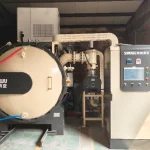
RVGQ-557 vacuum gas-quenching furnace with an air-duct structure
2026-09-30