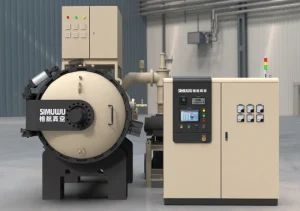
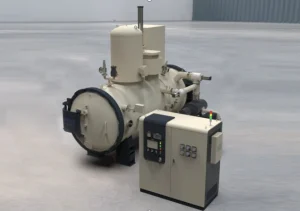
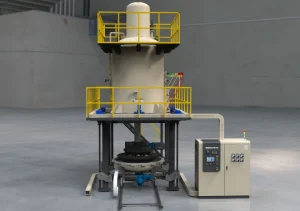
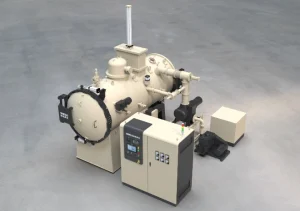
Vacuum heat treatment offers advantages such as superior surface quality, minimal deformation, and the absence of oxidation or decarburization, making it widely used for molds, tools, and precision mechanical components. As a critical stage in vacuum heat treatment, the quality of the vacuum tempering process affects not only the workpiece’s hardness, strength, and toughness but also its surface brightness. In actual production, workpieces may exhibit yellowing, blueing, graying, or even a loss of metallic luster after vacuum tempering. Therefore, further improving surface brightness after vacuum tempering is essential for enhancing product quality and production stability. Based on practical production experience, improvements can be achieved by increasing the vacuum level, mitigating the impact of water vapor from heat shields, employing rapid cooling, and enhancing temperature uniformity.
Increasing the vacuum level during the tempering process is a key measure for improving surface brightness.
During production, the vacuum level can be raised to approximately 1.3 × 10⁻² Pa to effectively reduce the concentration of residual oxygen and other reactive gases within the furnace. Tempering workpieces in a high-vacuum environment minimizes the likelihood of surface reactions with oxygen at high temperatures and reduces the formation of oxide films, thereby preserving the workpiece’s metallic luster. Additionally, the sealing integrity of the vacuum furnace must be rigorously maintained, components such as furnace doors, seals, valves, and vacuum piping require regular maintenance to ensure the vacuum system’s pumping efficiency and stability.
The impact of water vapor absorption and release by the furnace’s heat shields on tempering quality should be minimized.
Heat shields tend to adsorb atmospheric moisture during prolonged use—particularly when the furnace is idle or being opened—allowing water vapor to penetrate and be absorbed by the insulation material. Upon heating, this adsorbed moisture is released, increasing the water vapor content inside the furnace. At high temperatures, water vapor adversely affects the workpiece surface, thereby reducing brightness. Consequently, utilizing a metal heat shield design is a viable solution.
Employing rapid cooling is another important measure for enhancing surface brightness.
After the workpiece has completed the tempering soak, an excessively long dwell time in the high-temperature zone increases the likelihood of reactions with residual oxygen, water vapor, and other contaminants. Therefore, provided that performance specifications and equipment safety requirements are met, the cooling phase should commence as soon as possible to allow the workpiece to rapidly pass through the temperature range where surface oxidation is most likely to occur. Rapid cooling not only minimizes surface oxidation but also shortens the overall heat treatment cycle, thereby boosting production efficiency. However, the cooling rate should not be increased indiscriminately; it must be determined based on the workpiece material, dimensions, geometry, and final performance requirements.
Ensuring temperature uniformity within the furnace is crucial for maintaining the quality of vacuum tempering.
Significant temperature gradients within the furnace can lead to variations in the actual tempering temperature and holding time for workpieces located in different positions, potentially resulting in inconsistencies in surface color, hardness, and microstructure. Consequently, the vacuum furnace should undergo regular temperature uniformity testing and calibration, including checks on the operating status of heating elements, thermocouples, and temperature control systems. Additionally, workpieces should be loaded carefully to avoid overcrowding, ensuring uniform heat transfer throughout the furnace.
Enhancing the surface brightness of vacuum-tempered workpieces is a systematic process. By increasing the vacuum level to approximately 1.3 × 10⁻² Pa, minimizing water vapor outgassing from heat shields, optimizing rapid cooling procedures, and improving furnace temperature uniformity, it is possible to effectively reduce surface oxidation and contamination, thereby achieving a brighter surface finish. In actual production, process parameters should be continuously optimized based on equipment conditions, workpiece materials, and product specifications to achieve a comprehensive improvement in surface quality, mechanical properties, and production efficiency.
-
Applications of High-Temperature Vacuum Brazing Furnaces — Brazing of Stainless Steel
2026-11-23
-

Challenges in the Heat Treatment of Precision MIM Components
2026-11-20
-

SIMUWU Vacuum Furnaces: Stable and Excellent Furnace Temperature Uniformity
2026-11-16
-
Material Hardenability and Vacuum Quenching Furnaces
2026-11-13
-
Applications of Vacuum Annealing Furnaces – Titanium Crystallization Annealing Furnaces
2026-11-10