Even at fine vacuum levels (~10⁻⁴ mbar), residual oxygen molecules remain sufficient to initiate surface reactions at high temperatures. The process typically begins with thermal etching at grain boundaries, where higher surface energy facilitates oxide nucleation. As holding time increases, these nuclei spread into continuous oxide scales that can compromise subsequent coating adhesion or aesthetic requirements.
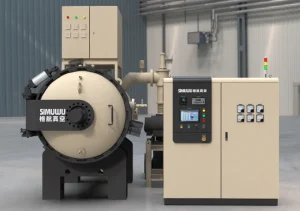
Engineers must balance the vacuum level with the vapor pressure of alloying elements. In a Vacuum Annealing Furnace, maintaining a strict vacuum-to-temperature ratio prevents the depletion of critical surface elements. Understanding the transition from grain boundary etching to full-scale oxidation is fundamental to achieving high-quality surface finishes.
1. Vacuum Post-Oxidation for Different Steels
1.1 Carbon Steels
Medium-carbon steels, such as 0.4% C steel, exhibit a high sensitivity to residual oxygen during austenitizing cycles. At 850 °C and a vacuum level of 10⁻⁴ mbar, oxidation initiates within 20 minutes, primarily along grain boundary grooves. Prolonged holding times (exceeding 4 hours) lead to the formation of nearly continuous oxide layers and potential blister formation.
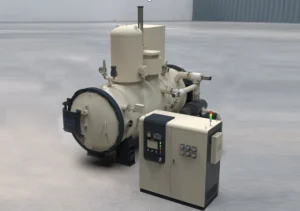
To optimize results for carbon steels, technical managers should minimize holding times once the workload reaches thermal equilibrium. Maintaining a vacuum level better than 10⁻⁴ mbar is recommended for critical components to delay the onset of grain boundary oxidation. Precision control in a Vacuum Tempering Furnace ensures that these surface effects do not propagate during lower-temperature cycles.
1.2 High-Speed Steels (HSS)
High-speed steels (HSS) like M35 and M2 require higher processing temperatures, often exceeding 1100 °C, which accelerates oxidation kinetics. For M35 steel, austenitizing at 1190 °C necessitates a high-purity vacuum environment to prevent decarburization and surface degradation. Optimization studies indicate that M2 steel achieves superior tool life when tempered at 510 °C following a vacuum austenitizing cycle at 1050–1150 °C.
1.3 Hot-Work Tool Steels (AISI H11)
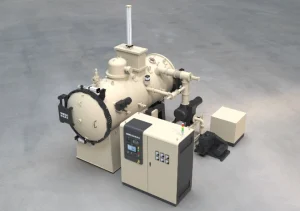
Hot-work steels, specifically H11, benefit from controlled quenching environments. Utilizing a Vacuum Gas Quenching Furnace with high-pressure Nitrogen (e.g., 1.05 bar) allows for rapid cooling while maintaining surface cleanliness. For H11, an austenitizing temperature of 1020 °C coupled with specific tempering cycles at 560–620 °C provides the optimal balance of hardness and fracture toughness (K_Ic).
1.4 Stainless Steels
Stainless steels like SUS304 demand high-vacuum conditions to maintain the characteristic “bright” finish after heat treatment. Thermal etching becomes a significant concern at temperatures between 970 °C and 1050 °C. While a vacuum level ≤ 1.33 Pa is generally sufficient, excessive holding times can lead to deep surface etching that dulls the appearance.
2. Recommended Parameter Ranges
| Steel Type | Austrianitizing Temp. (°C) | Tempering Temp. (°C) | Vacuum Level (Pa) | Key Optimization Consideration |
| Carbon steel (0.4%C) | 850 | — | ≤10⁻⁴ | Minimize holding time; avoid blister formation |
| HSS M35 | 1190 | 550 (×3) | 4.5 (heating) → 0.13 (austenitizing) | Remove all surface oxide before VHT |
| HSS M2 | 1050–1150 | 510 (×2) | 13 × 10⁻² | Lower Tₐ → higher K_Ic; temper at 510 °C for optimal tool life |
| Hot-work H11 | 1020 | 560–620 (×2) | N₂ quench at 1.05 bar | 1020 °C gives best K_Ic/HRc ratio; 45–48 HRc optimal for most applications |
| Stainless SUS304 | 970–1050 | — | ≤1.33 | 30 min at 970–1050 °C maximizes brightness; avoid excess thermal etching |
| AHSS DP980 | 810–843 | — | H₂/H₂O atmosphere (P_ratio 0.033–0.094) | Fast heating (≥27 K/s); moderate dew point for internal oxidation |
| High-Cr steel (13.5% Cr) | Pre-oxidize at 500 °C × 30 min | — | Dry air | Pre-oxidation reduces subsequent oxidation by 40% |
3. FQA
Q: What is the focus of Vacuum Post-Oxidation Optimization?
A: The primary focus is controlling the interaction between residual oxygen and the metal surface to prevent grain boundary etching, oxide scale formation, and decarburization during the thermal cycle.
Q: Does oxidation occur in a perfect vacuum?
A: In industrial practice, a “perfect” vacuum is unattainable. Residual gases always exist, and at high temperatures, even trace amounts of oxygen can cause selective oxidation of alloying elements like Chromium or Silicon.
Q: How does vacuum level affect stainless steel brightness?
A: Lower pressures (higher vacuum) reduce the probability of oxygen molecules striking the surface, thereby preventing the formation of visible oxide films that cause discoloration or “tinting.”
Q: Why is H11 steel quenched in Nitrogen?
A: Nitrogen is an inert, cost-effective cooling medium that provides sufficient quenching speeds for H11 while maintaining a clean, oxide-free surface compared to traditional salt bath or atmosphere quenching.
Q: Can vacuum post-oxidation be completely eliminated?
A: While it cannot be entirely eliminated, it can be suppressed below the threshold of functional or aesthetic significance through proper parameter optimization and high-performance vacuum pumping systems.
Precision in vacuum heat treatment determines the service life of high-performance components. By applying rigorous Vacuum Post-Oxidation Optimization, manufacturers can eliminate secondary cleaning processes and ensure superior metallurgical results.
-
Factors Affecting the Quality of Vacuum Heat Treatment
2026-09-22
-
Application of RVGQ-557 Vacuum Gas Quenching Furnace—Gas Quenching and Tempering
2026-09-18
-
The Role and Benefits of Equipping Vacuum Furnaces with Dew Point Meters
2026-09-15
-
How to Bake Out a Vacuum Furnace After Shutdown? A Complete Restart Guide
2026-09-11
-
Top-and-Bottom Blast Vacuum Gas Quenching Furnace
2026-09-08