1. Introduction to PM T42 High-Speed Steel
Engineers specify T42 cobalt-alloyed high-speed steel for heavy-duty cutting tools and high-wear structural parts due to its exceptional hot hardness and wear resistance. The standard chemical composition of T42 contains high fractions of strong carbide formers, backed by a substantial cobalt addition of Co to bolster thermal stability.
Powder metallurgy manufacturing processes bypass the severe carbide segregation typical of large wrought ingots by deploying pre-alloyed water-atomized or gas-atomized powders. This processing route achieves a highly uniform, isotropic microstructural dispersion of hard primary carbides within the ferrous matrix, avoiding structural weak points. However, achieving near-theoretical density (>98%) and optimizing the grain boundary networks requires a highly controlled industrial thermal cycle.
2. The Metallurgy of Vacuum Sintering of T42 High-Speed Steel
Understanding the thermodynamics of vacuum sintering of T42 high-speed steel is critical for engineers seeking to achieve full densification without provoking deleterious grain growth. The physical transition from a cold-compacted green body (typically showing sim 70% theoretical density) to a fully dense component is governed by liquid phase formation and atmospheric reactions.
2.1 Supersolidus Liquid Phase Sintering (SLPS) Mechanisms
Supersolidus liquid phase sintering serves as the primary densification mechanism during the pressureless vacuum sintering of high-speed tool steels. When the temperature of the compacted T42 pre-alloyed powder exceeds its solidus temperature, liquid nucleates inside the powder particles and flows along the grain boundaries. This microstructural liquid film exerts high capillary forces that rapidly drag the solid grains together, resulting in swift pore elimination and massive densification.
To successfully execute this mechanism, operators typically add a small portion of graphite powder to the initial mix. This carbon addition lowers the optimum sintering temperature and widens the sintering window. The sintering window is defined as the thermal interval between the solidus temperature and the onset temperature of coarse, brittle eutectic carbide network formation.
2.2 Nitrogen Atmosphere Pressureless Sintering vs. Vacuum Sintering
Sintering atmosphere composition dramatically shifts the thermodynamic phase boundaries of the T42 system, directly impacting the process reliability. While vacuum sintering of T42 with carbon addition requires an OST of approximately 1220℃ and offers a tight SW of only sim 10℃, introducing nitrogen gas alters these values favorably.
Under a nitrogen-rich partial pressure of 0.9 bar, the OST decreases sharply to 1160℃, while the sintering window expands to 30 to 40℃. This thermodynamic shift occurs because nitrogen behaves as an interstitial alloying element, stabilizing the austenite phase and lowering the liquidus/solidus boundaries.
The progressive absorption of nitrogen triggers a carbonitride transition, changing vanadium-rich MC carbides into more stable M(C,N) carbonitrides. This chemical evolution releases free carbon back into the ferrous matrix, increasing the thermodynamic separation between the solidus line and the eutectic melting boundary.
However, engineers must avoid excessive nitrogen pressures (such as 8 bar), which force nitrogen absorption up to 1.00 wt.%. Such extreme absorption triggers a ternary eutectic reaction, yielding massive networks of coarse M₃C cementite-type carbides (specifically identified as molybdenum-rich Fe₂MoC-type phases). These brittle networks restrict the sintering window to 0°C and severely degrade the toughness of the finished tool steel.
3. Sintering Window Optimization and Furnace Technology
Maintaining precise thermal control inside the furnace hot zone determines whether a production batch achieves high performance or suffers from structural defects. Because the sintering window for vacuum-processed T42 is narrow, any temperature overshoot exceeding 10°C will initiate localized grain-boundary melting, leading to coarse eutectic carbide films.
To prevent decarburization during the high-temperature hold, the vacuum level and gas composition must remain tightly regulated. Under high vacuum, carbon reacts with surface oxides to form gaseous carbon monoxide (CO), reducing the overall carbon content. Introducing high-purity nitrogen or argon backfill gas at specific temperature checkpoints (such as 895°C) halts uncontrolled outgassing and stabilizes the carbon balance.
4. Post-Sintering Heat Treatment and Microstructure Design
Sintered T42 parts must undergo tailored post-sintering heat treatments to transition their microstructure from a soft pearlitic state to either a high-hardness cutting phase or a high-toughness structural phase.
4.1 Austenitizing, Quenching, and Multitempering
To achieve maximum cutting hardness sim 66 HRC or up to 1100 HV2), parts undergo austenitization, quenching, and subsequent triple tempering. Austenitizing at temperatures between 1000℃ and 1100℃ dissolves a portion of the secondary carbides, enriching the parent austenite matrix with carbon and carbide-forming alloy elements.
Quenching in high-pressure gas or oil transforms the austenite into a highly stressed, twinned lath and plate martensitic matrix. This rapid cooling retains a high volume fraction of metastable austenite (up to 80%), which requires subsequent triple tempering cycles at 500℃ to 550℃ to fully destabilize.
During these tempering treatments, chromium-rich cementite-type phases (Fe,Cr)₃C and tungsten-rich M₆C carbides undergo secondary nanometric precipitation (sized 25 to 200 nm). This dense dispersion of secondary precipitates blocks dislocation movement, prompting a pronounced secondary hardening peak.
4.2 Isothermal Annealing for Balanced Structural Performance
When T42 is deployed in structural wear parts, such as high-performance valve seat inserts, extreme cutting hardness is discarded in favor of balanced mechanical toughness. An intermediate hardness of approximately 50 HRC is ideal for structural ductility and machining.
This intermediate property profile is efficiently achieved via isothermal annealing directly below the lower critical temperature, rather than conventional quenching and tempering. Austenitizing at a lower temperature (950℃), transferring directly into a salt or gas bath at 660℃, and holding for 3 to 24 hours yields a fine-grained, globular pearlitic matrix.
This isothermal annealing process relies on the presence of proeutectoid nanometric M₆C carbides. These tiny carbides effectively pin the ferrite grain boundaries, suppressing the growth of coarse lamellar pearlite and yielding a highly stable, ductile dispersion of submicron spherical carbides.
5. Selecting the Ideal Vacuum Sintering and Heat Treatment Equipment
Choosing the appropriate furnace configuration is paramount to executing these high-precision thermal cycles on an industrial scale. Manufacturers must match their microstructural goals with the exact capabilities of modern industrial vacuum systems.
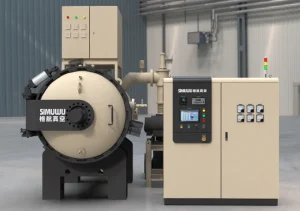
For the initial consolidation stage, a Vacuum Dewaxing & Sintering Furnace provides the ultimate platform. These systems feature advanced debinding traps to safely remove organic compaction lubricants, alongside precise gas dosing valves that maintain the optimal 0.9 bar nitrogen atmosphere required to expand the T42 sintering window.
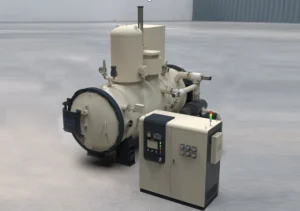
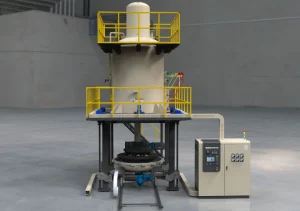
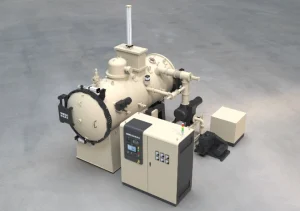
Following successful sintering, parts must be hardened with supreme precision. A high-efficiency Vacuum Gas Quenching Furnace or a Dual-chamber Vacuum Oil Quenching Furnace delivers the fast cooling rates needed to secure the desired martensitic transformation. Finally, utilizing a specialized Vacuum Tempering Furnace guarantees uniform secondary precipitation across complex batches, maximizing service life.
6. FAQ
Why is cobalt added to T42 high-speed steel if it does not form carbides?
Cobalt dissolves directly into the iron matrix, increasing the Curie temperature and providing substantial solid-solution strengthening at high operating temperatures. This guarantees that tools made of T42 retain their cutting edge and yield strength even under severe red-heat operating conditions.
What is the main risk of sintering T42 under vacuum without nitrogen gas?
Vacuum sintering without nitrogen reduces the sintering window to a narrow range (sim 10℃). Any minor temperature fluctuation inside the hot zone can cause localized overheating, leading to the formation of brittle grain-boundary liquid phases and catastrophic structural failure during subsequent tool operations.
Can water-atomized T42 powder achieve full densification without pressure-assisted sintering?
Yes, pressureless supersolidus liquid phase sintering (SLPS) under controlled nitrogen partial pressures can easily yield densities exceeding 99% theoretical density, matching the structural properties of pressure-assisted hot isostatic pressing (HIP) at a fraction of the processing cost.
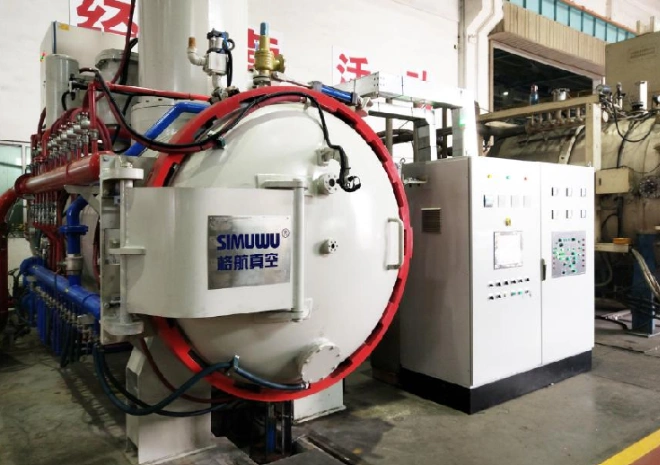
Mastering the vacuum sintering of T42 high-speed steel requires absolute control over atmospheric compositions, thermodynamic boundaries, and subsequent tempering cycles. By integrating high-precision nitrogen atmosphere control with rapid quenching systems, manufacturing facilities can consistently produce defect-free HSS tools showing exceptional wear resistance and long-term dimensional stability.
Are you looking to optimize your powder metallurgy sintering yields and improve carbide dispersion? Contact SIMUWU today to discuss our custom heat treatment furnace and request a technical consultation with our engineering team.
-
Machining of Precision Automotive Components: Application of High-Pressure Vacuum Gas Quenching
2026-10-16
-
How to Enhance the Surface Brightness of Vacuum Tempered Workpieces
2026-10-13
-
Production of High-Pressure Die-Casting Molds: Application of Vacuum Gas-Quenching Furnaces
2026-10-08
-
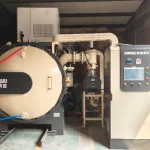
RVGQ-557 vacuum gas-quenching furnace with an air-duct structure
2026-09-30
-

The Role of Nitrogen Partial Pressure in Vacuum Furnaces
2026-09-25