1. Material
1.2361 corresponds to the US standard A8 and is an air-hardening cold-work tool steel containing high chromium, molybdenum, and vanadium. Its characteristics include:
- 1. Excellent hardenability; it can be hardened via high-pressure gas quenching, eliminating the need for oil quenching.
- 2. Toughness superior to D2 and wear resistance superior to O1; commonly used for precision tools, thin-sheet cutting blades, long cutters, slender blanking tools, and thin saw blades.
- 3. Good plasticity when heated to high temperatures; prone to bending under its own weight and warping/deformation in thin-walled parts; highly sensitive to the fixturing method used during heat treatment.
Vacuum gas quenching offers significant advantages over oil quenching for 1.2361 tools: the vacuum environment completely prevents workpiece oxidation and decarburization, ensuring stable carbon content at the cutting edge and a pure, uniform microstructure; controlled, gradual gas cooling drastically reduces thermal stress, effectively minimizing the risk of deformation and cracking in long, thin-sheet tools; it avoids localized soft or hard spots caused by oil residue or carbon buildup; workpieces emerge with a bright, clean surface, eliminating complex degreasing and cleaning steps; process parameters can be precisely and stably controlled, ensuring consistent hardness across batches; and it eliminates the consumption of quenching oil and associated waste oil disposal costs, resulting in finished tools with superior wear resistance and chipping resistance.
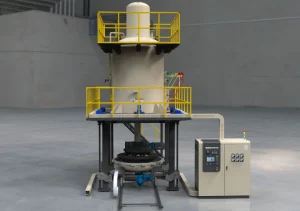
2. Vertical Suspension Method for Distortion Control
The austenitizing temperature for 1.2361 is approximately 980–1030°C. Due to low high-temperature strength, slender or thin tools placed flat on a tray—subjected to compressive stress from bottom supports and slower cooling at contact surfaces—are highly prone to bending, warping, surface unevenness, and edge twisting. Therefore, we typically employ a suspension method for vacuum gas quenching; the primary advantages are as follows:
- 1. Significant reduction in sagging deformation due to self-weight: In horizontal furnaces, workpieces lie flat with few support points, making slender tools (such as taps, drill bits, long reamers, broaches, and cylindrical cutters) prone to bending after softening at high temperatures. In contrast, vertical suspension involves clamping only the top end, eliminating bottom support indentations and thermal resistance differences at contact surfaces; this markedly improves the straightness and roundness of long, thin tools and significantly reduces the allowance required for subsequent grinding.
- 2. Uniform cooling with no contact-induced temperature differentials: When tools lie flat, heat dissipation is slow at the points of contact with the tray, leading to localized tempering (soft spots) and uneven hardness. In contrast, suspended tools are fully enveloped by high-pressure cooling gas, ensuring simultaneous 360° cooling; this results in a consistent hardness gradient across the entire tool, preventing localized soft zones or uneven hardness between sides.
- 3. Controllable deformation for thin-walled or complex-shaped tools: Suspending tools—such as profile milling cutters, thin saw blades, and precision punches—during cooling eliminates stress caused by tray contact, significantly reducing warping and twisting defects compared to horizontal stacking.
3. Vertical Vacuum Gas Quenching Furnace Technical Parameters
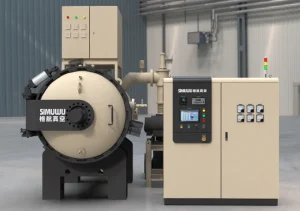
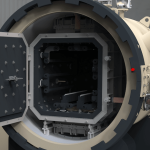
SIMUWU’s RVGQ-V0909 vertical vacuum gas quenching furnace is equipped with a Siemens S7-1200 PLC and a database containing over 10,000 process recipes (including for 1.2361 steel), enabling precise execution of suspended vacuum gas quenching processes. Key specifications are listed below:
| Furnace type | Vertical,single chamber,internal cycle |
| Loading method | Bottom loading |
| Max. Loading size | Φ900×900(D x H mm) |
| Max. Loading weight | 1000kg(Including Jig) |
| Power supply | 3Phase 380V(±5% );50Hz |
| Total power | 260kw |
| Heating power | 225kw |
| Cooling fan motor power | 200kw |
| Max.design temperature | 1300℃ |
| Working temperature | 1250℃ |
| Temperature uniformity | ±5(Measurement taken after thorough soaking at 1000°C.) |
| Temperature control accuracy | S Type thermocouple ≤ ±1℃ |
| Quantity of heating zones | Independent temperature control for 3 zones |
| Heating element | High purity graphite |
| Ultimate vacuum(Empty furnace, cold state, after drying and degassing) | 6.7 x 10⁻⁵mbar(empty furnace, cold state, after thorough drying) |
| Working vacuum | 6.7 x 10⁻⁴mbar |
| Pressure rise rate | ≤0.67Pa/h(Empty furnace, cold state) |
| Cooling method | Gas cooling/natural cooling |
| Cooling air | Nitrogen or Argon (purity: 99.99% or 99.999%) |
| Cooling rate (empty furnace) | ≤6min(From 1200℃ to 150℃) |
| Max charging pressure(absolute pressure and adjustable) | <10bar |
| Partial pressure | 50–1000 Pa manual and automatic partial pressure control |
| Control mode | PLC automatic / manual control interlock protection |
| Equipment color | Customized |
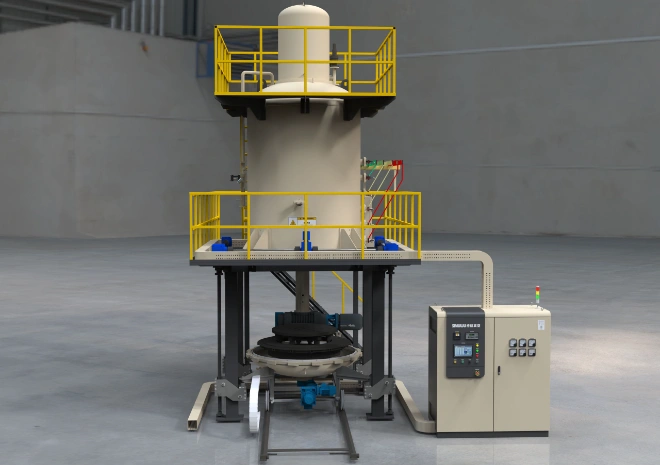
Should you have any technical questions or requests, please feel free to contact simuwuvacuumfurance@gmail.com at any time; we are dedicated to serving you.
-
RVGQ-557 vacuum gas-quenching furnace with an air-duct structure
2026-09-30
-

The Role of Nitrogen Partial Pressure in Vacuum Furnaces
2026-09-25
-
Factors Affecting the Quality of Vacuum Heat Treatment
2026-09-22
-
Application of RVGQ-557 Vacuum Gas Quenching Furnace—Gas Quenching and Tempering
2026-09-18
-
The Role and Benefits of Equipping Vacuum Furnaces with Dew Point Meters
2026-09-15