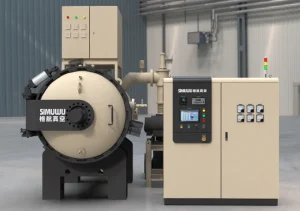
The principles of vacuum heat treatment of steel involve precise control over microstructural transformations in an evacuated thermal environment. This processing technique eliminates reactive atmospheric gases to yield clean, oxide-free material surfaces. The overall cycle consists of three fundamental metallurgical stages: heating for austenitization, rapid cooling for quenching, and subsequent tempering. Each specific stage induces defined physical and crystallographic changes that determine the final mechanical properties of the targeted alloy.
1. Phase Transformations During Heating in Vacuum
Heating steel components inside a vacuum furnace initiates surface and internal microstructural changes. Operating at specific sub-atmospheric pressures alters the thermodynamic stability of surface compounds. Control of the heating ramp rate and temperature uniformities defines the subsequent transformations.
1.1 Physics of the Vacuum Environment
Applying heat to steel within a vacuum environment prevents oxidation and active decarburization mechanisms. A controlled vacuum systematically removes adsorbed gases and forces the dissociation of pre-existing unstable surface compounds. Managing the exact furnace pressure is mandatory to prevent the evaporation of high-vapor-pressure alloying elements. For example, specific partial pressures must be established when processing high-chromium alloys to suppress chromium sublimation from the substrate.
1.2 Austenite Formation and Carbide Dissolution
Raising the core temperature above the Ac1 and Ac3 critical points forces the body-centered cubic ferrite to transform into face-centered cubic austenite. Industrial heating cycles utilize step-heating protocols, such as preheating tool steels at 550°C and 850°C, to minimize internal thermal gradients. Elevating the final austenitization temperature accelerates the dissolution of primary carbides into the matrix. This dissolution directly enriches the austenite with carbon and alloying elements, governing the subsequent martensite start temperature and retained austenite fractions.
1.3 Surface Reactions and Decarburization Prevention
Vacuum environments alter the chemical interactions between residual surface oxides and the carbon substrate. Substrate carbon diffuses outward to reduce residual iron oxides at temperatures exceeding 800°C, generating carbon monoxide emissions. This specific reaction depletes the surface carbon concentration and measurable surface hardness. Mechanical or chemical surface preparation to remove oxide layers prior to heating is required to maintain the specified surface carbon content and ensure uniform hardening.
2. Phase Transformations During Cooling and Quenching
Controlled heat extraction converts the austenitic structure into hardened martensite. The selected cooling medium and operational pressure dictate the precise cooling rate. Managing this rate dictates the resultant microstructural balance and dimensional accuracy.
2.1 Vacuum Furnace Cooling Methods
Vacuum thermal processing utilizes variable cooling protocols, predominantly pressurized inert gas quenching using nitrogen or argon. Forced gas circulation extracts thermal energy uniformly across the load cross-section. The exact cooling rate achieved correlates directly with the injected gas pressure, volumetric flow rate, and the overall thermal mass of the furnace load.
2.2 Martensitic Transformation Kinetics
Rapid cooling initiates the diffusionless, shear-type transformation of austenite into a supersaturated body-centered tetragonal martensite structure. The volumetric fraction of generated martensite depends on the degree of undercooling below the martensite start temperature. Slowing the cooling rate below the martensite start point triggers an auto-tempering phenomenon. Carbon diffuses from initially formed martensite into adjacent un-transformed austenite, lowering its transformation temperature and delaying final microstructural conversion.
2.3 Control of Retained Austenite
Gas quenching within vacuum systems typically executes lower absolute cooling rates compared to traditional liquid quenching media. This reduced thermal extraction rate promotes austenite stabilization, generating higher fractions of retained austenite at room temperature. Quenching high-alloy tool steels in vacuum produces significant retained austenite volumes requiring engineered post-quench treatments. Controlling this phase is necessary to prevent spontaneous, uncontrolled transformation during service.
2.4 Distortion and Dimensional Changes
The crystallographic expansion from densely packed austenite to martensite induces localized volumetric changes and internal stress. Combined thermal gradients and non-uniform phase transformations generate measurable axial stress and deviations in part geometry. Implementing uniform gas flow mapping across the targeted load mitigates uneven phase distribution and limits dimensional distortion.
3. Phase Transformations During Tempering
The principles of vacuum heat treatment of steel dictate that quenched structures require immediate tempering. Tempering consists of reheating the hardened component to sub-critical temperatures to relieve internal stresses. The applied thermal energy modifies the brittle martensite into a tougher, industrially usable structure.
3.1 Microstructural Evolution Stages
Applying thermal energy during tempering initiates sequential, temperature-dependent metallurgical mechanisms.
- Stage I (Ambient to 200°C): Carbon segregates to dislocations, initiating transition carbide precipitation.
- Stage II (200°C to 300°C): Retained austenite decomposes into localized bainitic ferrite and carbide clusters.
- Stage III (250°C to 400°C): Transition carbides dissolve, replaced by the formation of stable cementite.
- Stage IV (Above 400°C): Existing carbides coarsen while alloy steels undergo secondary hardening via fine alloy carbide precipitation.
3.2 Carbon Partitioning in High-Silicon Steels
Alloying steel with silicon fundamentally alters the kinetics of carbon redistribution during tempering cycles. Carbon diffuses from the supersaturated martensite into adjacent retained austenite between 250°C and 350°C without initiating phase decomposition. Increasing the temperature above 400°C bypasses stabilization and forces the rapid breakdown of the austenite into pearlite-like microstructures.
3.3 Secondary Hardening and Fracture Toughness
Processing hot-work tool steels involves tempering within the secondary hardening range of 500°C to 600°C. This specific temperature range precipitates fine alloy carbides, generating a calculated peak in material hardness. Modulating the final tempering temperature precisely defines the ratio between maximum surface hardness and internal fracture toughness.
3.4 Multiple Tempering Cycle Implementation
High-alloy steels retaining large fractions of austenite mandate the execution of multiple, consecutive tempering cycles. Each independent thermal cycle transforms a discrete volume of the retained austenite into untempered martensite during the cooling phase. Subsequent heating cycles act to temper the newly formed martensite and relieve accumulated transformation stresses.
4. Summary of Process-Structure-Property Relationships
Operational parameters inputted during vacuum heat treatment define the final properties. The interactions are summarized below.
| Stage | Key Transformation | Critical Parameters | Outcome |
| Heating | Ferrite to Austenite; Carbide dissolution | Temperature, time, vacuum level, heating rate | Austenite composition; surface quality |
| Cooling | Austenite to Martensite | Cooling rate, gas pressure, Ms temperature | Hardness; retained austenite fraction; distortion |
| Tempering | Martensite decomposition; Carbide precipitation | Temperature, time, number of cycles | Final hardness; toughness; dimensional stability |
5. FAQ
What drives the decarburization prevention mechanism in vacuum processing?
Removing reactive atmospheric gases eliminates the chemical pathways required to extract carbon from the steel surface matrix.
How does gas pressure alter the quenching outcome?
Increasing the inert gas pressure raises the density of the cooling medium, accelerating thermal transfer and martensite conversion.
Why are multiple tempering cycles specified for high-alloy steels?
High-alloy steels retain high levels of austenite after quenching; multiple cycles systematically transform this phase while tempering the newly generated martensite.
Executing the correct principles of vacuum heat treatment of steel determines the operational lifespan of the manufactured component. Validate your structural transformation requirements by reviewing data from the ASM International Heat Treating Society. Implement targeted thermal profiles using equipment designed for your specific material group. Contact our engineering division to configure thermal processing parameters.
-
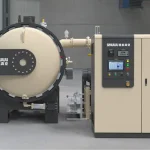
Production of High-Pressure Die-Casting Molds: Application of Vacuum Gas-Quenching Furnaces
2026-10-08
-
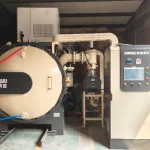
RVGQ-557 vacuum gas-quenching furnace with an air-duct structure
2026-09-30
-

The Role of Nitrogen Partial Pressure in Vacuum Furnaces
2026-09-25
-
Factors Affecting the Quality of Vacuum Heat Treatment
2026-09-22
-
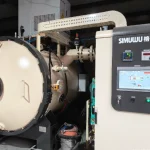
Application of RVGQ-557 Vacuum Gas Quenching Furnace—Gas Quenching and Tempering
2026-09-18