1. The Mechanics of Vacuum Quenching for Sintered T42 Tool Steels
Sintered T42 is a premium powder metallurgy (PM) high-speed steel characterized by a high nominal alloy composition of Fe-1.32C-10.58Co-4.20Cr-3.82Mo-3.32V-9.98W(wt.%). To achieve near-full densification (≥98% theoretical density), the cold-pressed green compacts are processed under vacuum or controlled nitrogen atmospheres in a Vacuum Dewaxing & Sintering Furnace or a specialized SIC Vacuum Sintering Furnace at an optimum sintering temperature (OST) of 1220℃.
Once densified, the alloy requires a rigorous austenitizing and quenching cycle to develop its exceptional hot hardness and wear resistance. Choosing the correct vacuum quenching for sintered T42 components determines the final distribution of carbide phases and the morphology of the martensitic matrix, which ultimately dictates tool life under harsh cutting environments.
2. Cooling Rates and Phase Transformation Characteristics
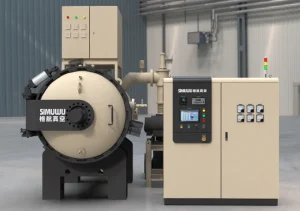
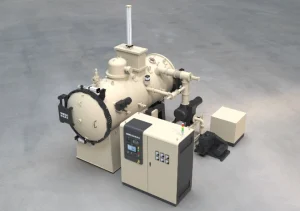
The core distinction between gas and oil quenching is the heat extraction rate. Traditional oil quenching in a Dual-chamber Vacuum Oil Quenching Furnace provides rapid heat transfer, quickly passing through the critical range of 800℃ to 500℃ to avoid proeutectoid carbide precipitation. This produces an as-quenched matrix consisting of plate and lath martensite, approximately 17% to 20% retained austenite, and a highly dispersed distribution of nanometric proeutectoid M₆C carbides.
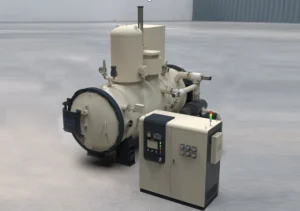
Conversely, gas quenching in a Vacuum Gas Quenching Furnace utilizes pressurized nitrogen gas as the cooling medium. Slower cooling rates at lower gas pressures allow proeutectoid carbides more time to nucleate and grow along prior austenite grain boundaries, leading to quench embrittlement. To prevent this, modern systems increase nitrogen pressure to 5 bar or 10 bar in a Dual-chamber Vacuum Gas Quenching Furnace, yielding cooling rates that approach oil-like performance for small-to-medium cross-sections.
2.1 Impact of Gas Pressure on Secondary Carbides
Research on high-speed steels undergoing vacuum heat treatments shows that increasing the quenching gas pressure dramatically refines secondary carbide precipitation. In comparable cobalt-alloyed high-speed steels, raising the nitrogen quenching pressure from 5 bar to 6 bar increases the area fraction of small secondary carbides (0.1 μm ≤ size ≤ 1.0 μm) from 2.53±0.15% to 3.49±0.17%.
Concurrently, the average size of these carbides decreases from 0.74±0.08 μm to 0.58±0.07 μm. This grain-boundary and carbide refinement improves dispersion hardening but must be carefully managed, as exceeding 8 bar can lead to an excessive density of ultra-fine carbides that may provide a preferential path for crack propagation.
3. Mechanical Properties: Hardness and Fracture Toughness
Both oil and gas quenching can achieve excellent hardness profiles in sintered T42 tool steels, provided the cooling rate successfully bypasses the pearlite nose. Following oil quenching from an austenitizing temperature of 1000℃ to 1100℃ and undergoing triple tempering in a Vacuum Tempering Furnace at 500℃, sintered T42 achieves a peak secondary hardness of approximately 66 HRC (or ≈ 1086 HV2).
High-pressure gas quenching at pressures of ≥ 5 bar yields comparable hardness values of 64 HRC to 67 HRC in smaller cross-sections. However, fracture toughness is highly sensitive to the quench medium. Slower gas cooling at inadequate pressures promotes a semi-continuous network of grain-boundary carbides, reducing fracture toughness and encouraging intergranular failure.
When optimized at 6 bar nitrogen pressure, gas-quenched steels display optimized plane strain fracture toughness Kc of up to 32 MPa·m½. This enhancement is driven by a uniform dispersion of fine secondary carbides that deflect crack propagation and a matrix with high mechanical stability.
4. Distortion and Dimensional Stability
Distortion during quenching is a critical pain point for tool designers, occurring due to thermal stresses (uneven cooling between surface and core) and transformation stresses (volume changes during the austenite-to-martensite transition).
Empirical data reveals that gas quenching minimizes distortion due to the absence of the liquid-to-vapor phase transition (boiling stages) characteristic of oil quenching. In vacuum-treated components, high-pressure nitrogen gas quenching results in an average radial deformation of 6±4 μm, whereas oil quenching results in a significantly higher and less predictable deformation of 12±9 μm.
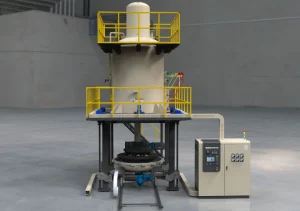
Because sintered T42 produced via the powder metallurgy route possesses an isotropic carbide distribution, pairing this material with the uniform heat extraction of a Vertical Type Vacuum Gas Quenching Furnace produces highly predictable, isotropic dimensional changes. This predictability allows engineers to calculate exact machining tolerances prior to heat treatment, significantly reducing post-quench finish grinding costs.
5. Practical and Environmental Considerations
From an operational standpoint, gas quenching in a vacuum furnace eliminates the post-quench washing stage. Oil-quenched parts are covered in oil residue, requiring wash cycles in hot alkaline baths that generate hazardous wastewater. Gas-quenched components emerge from the furnace dry, bright, and completely scale-free, saving floor space, reducing cycle times, and decreasing environmental footprint.
However, gas quenching is subject to section-size limits. Due to the lower heat transfer coefficient of nitrogen compared to liquid quenchants, extremely large components (typically >100mm in diameter) cannot be fully through-hardened using gas alone. Sintered T42 possesses excellent hardenability due to its 10.58 wt.% cobalt content, meaning most small-to-medium tooling parts are ideal candidates for gas quenching, while oil quenching remains reserved for massive structural components.
6. Technical Comparison Summary
The table below summarizes the key differences between gas and oil vacuum quenching for sintered T42 components:
| Feature | Vacuum Gas Quenching (≥5 bar) | Vacuum Oil Quenching |
| Cooling Power | Moderate to high (adjustable via pressure) | Very high (fixed by oil properties) |
| Through-Hardening Limit | Up to 100mm diameter | Suitable for all commercial sizes |
| Average Distortion | Low (±6 μm, highly predictable) | High (12±9 μm, anisotropic) |
| Post-Quench Surface | Bright, clean, dry | Covered in oil, requires washing |
| Retained Austenite | Slightly lower (≈ 10.8%) | High (≈ 17% – 20%) |
| Environmental Impact | Minimal (reusable Nitrogen/Argon) | High (wastewater and oil disposal) |
| Primary Failure Mode | Quasi-cleavage (microvoid decohesion) | Quasi-cleavage (pore-initiated) |
7. FAQ
Q1: Can gas quenching achieve the same wear resistance as oil quenching for sintered T42?
Yes. Since both methods can achieve peak hardness values of 66HRC after triple tempering at 500℃ to 550℃ in a Vacuum Tempering Furnace, the abrasive wear resistance of the resulting tempered martensite matrix is virtually identical.
Q2: What is the optimal nitrogen pressure for gas quenching sintered T42 parts?
For most standard tool dimensions, a nitrogen gas pressure of 5bar to 6bar is optimal. This pressure range provides cooling rates fast enough to prevent boundary carbide networks while avoiding the over-refinement of secondary carbides that occurs at 8bar, which can reduce toughness.
Q3: Why is sintered T42 more suitable for gas quenching than conventional tool steels?
Sintered T42 contains high amounts of cobalt along with tungsten, molybdenum, and vanadium. This highly alloyed composition significantly increases the material’s hardenability, allowing it to fully transform into a martensitic structure even under the moderate cooling rates of high-pressure gas quenching.
For manufacturing facilities looking to minimize finish-grinding costs and improve the toughness of sintered tool steels, choosing high-pressure gas vacuum quenching for sintered T42 is a highly effective, environmentally clean strategy.
-
Machining of Precision Automotive Components: Application of High-Pressure Vacuum Gas Quenching
2026-10-16
-
How to Enhance the Surface Brightness of Vacuum Tempered Workpieces
2026-10-13
-
Production of High-Pressure Die-Casting Molds: Application of Vacuum Gas-Quenching Furnaces
2026-10-08
-
RVGQ-557 vacuum gas-quenching furnace with an air-duct structure
2026-09-30
-

The Role of Nitrogen Partial Pressure in Vacuum Furnaces
2026-09-25