Applications of Vacuum Debinding and Sintering Furnace
In metal 3D printing technologies—particularly Metal Injection Molding (MIM) and indirect metal 3D printing methods such as Binder Jetting or extrusion-based FDM/FFF—”vacuum debinding” and “sintering” are two critical post-processing steps that determine the success or failure of the final part.
During the printing process, the binder (typically a polymer, wax, or resin) serves to hold the metal powder together and maintain the part’s shape. However, in the final metal component, these binders are considered “impurities” and must be completely removed. Following debinding, the resulting “brown part” is riddled with microscopic pores—spaces previously occupied by the binder—and the metal particles are merely in loose contact with one another. Sintering employs high temperatures to truly fuse these metal particles together.
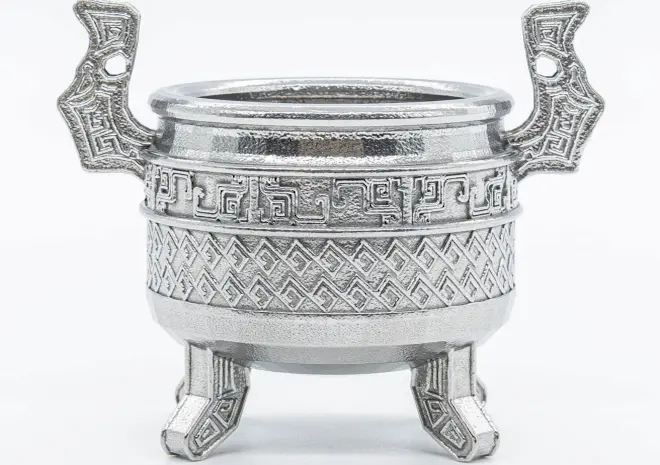
If debinding is incomplete, residual binder will carbonize at high sintering temperatures, causing the metal part to become brittle, crack, or deform severely. Conversely, if sintering is insufficient, metal particles fail to fuse properly, leaving the part riddled with porosity—making it as fragile as foam and prone to crumbling under pressure. Therefore, these two steps are essential for ensuring that metal 3D-printed parts achieve industrial-grade strength.
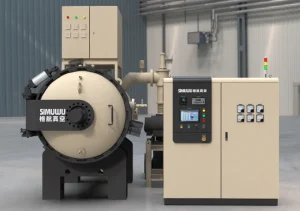
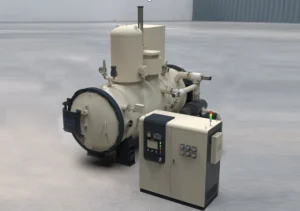
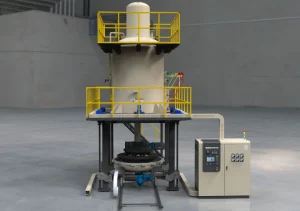
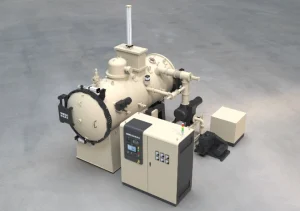
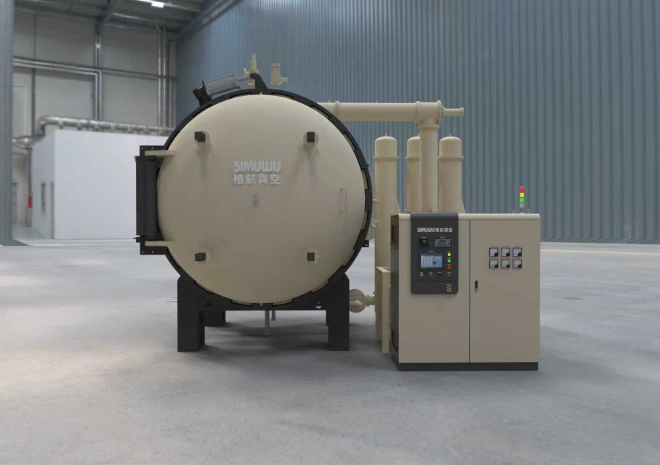
The SIMUWU RVS-335-D vacuum debinding and sintering furnace is equipped with vacuum, electrical control, water-cooling, and wax-trapping systems, making it widely applicable to processes such as metal injection molding and metal 3D printing. Additionally, its use of high-temperature molybdenum alloys and a vacuum system featuring a diffusion pump enables it to process advanced, high-performance materials like titanium alloys. Detailed specifications are provided below:
| Furnace type | Vertical,single chamber,internal cycle |
| Loading method | Bottom loading |
| Max. Loading size | Φ900×900(D x H mm) |
| Max. Loading weight | 1000kg(Including Jig) |
| Power supply | 3Phase 380V(±5% );50Hz |
| Total power | 260kw |
| Heating power | 225kw |
| Cooling fan motor power | 200kw |
| Max.design temperature | 1300℃ |
| Working temperature | 1250℃ |
| Temperature uniformity | ±5(Measurement taken after thorough soaking at 1000°C.) |
| Temperature control accuracy | S Type thermocouple ≤ ±1℃ |
| Quantity of heating zones | Independent temperature control for 3 zones |
| Heating element | High purity graphite |
| Ultimate vacuum(Empty furnace, cold state, after drying and degassing) | 6.7 x 10⁻⁵mbar(empty furnace, cold state, after thorough drying) |
| Working vacuum | 6.7 x 10⁻⁴mbar |
| Pressure rise rate | ≤0.67Pa/h(Empty furnace, cold state) |
| Cooling method | Gas cooling/natural cooling |
| Cooling air | Nitrogen or Argon (purity: 99.99% or 99.999%) |
| Cooling rate (empty furnace) | ≤6min(From 1200℃ to 150℃) |
| Max charging pressure(absolute pressure and adjustable) | <10bar |
| Partial pressure | 50–1000 Pa manual and automatic partial pressure control |
| Control mode | PLC automatic / manual control interlock protection |
| Equipment color | Customized |
Should you have any technical questions or requests, please feel free to contact simuwuvacuumfurance@gmail.com at any time; we are dedicated to serving you.
-
Machining of Precision Automotive Components: Application of High-Pressure Vacuum Gas Quenching
2026-10-16
-
How to Enhance the Surface Brightness of Vacuum Tempered Workpieces
2026-10-13
-
Production of High-Pressure Die-Casting Molds: Application of Vacuum Gas-Quenching Furnaces
2026-10-08
-
RVGQ-557 vacuum gas-quenching furnace with an air-duct structure
2026-09-30
-

The Role of Nitrogen Partial Pressure in Vacuum Furnaces
2026-09-25