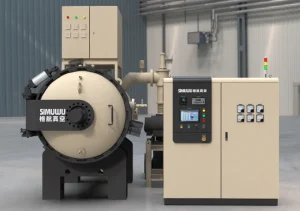
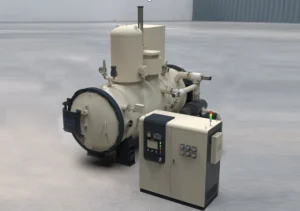
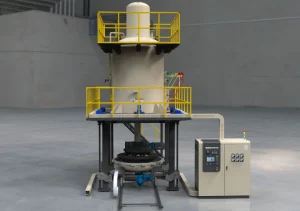
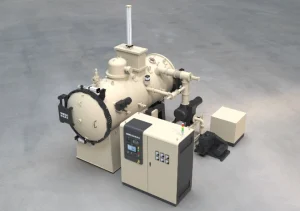
Vacuum gas quenching furnace faults and solutions part II extends system-level failure analysis from pumping, heating, and quenching performance into auxiliary subsystems, including water cooling, furnace door sealing, electrical protection circuits, and final heat treatment quality deviations in a Vacuum Gas Quenching Furnace.
5. Water cooling system faults
Water cooling stability is a critical constraint in Vacuum Gas Quenching Furnace operation because it directly affects thermal load management of pumps, seals, electrodes, and furnace walls. Any deviation in cooling performance propagates rapidly into system-wide instability.
Leaks typically occur at pipeline joints, flexible hoses, and cooling jackets due to long-term thermal cycling and mechanical vibration. Even minor leakage leads to gradual pressure loss and localized overheating of critical components.
Scaling and blockage are driven by dissolved minerals and particulate contamination in cooling water. Deposits reduce internal diameter of cooling channels and significantly decrease heat transfer efficiency.
Low inlet pressure or elevated inlet water temperature further reduces cooling capacity. When inlet water temperature exceeds design limits, heat rejection capacity of the entire system drops, triggering over-temperature alarms and protective shutdowns.
Corrective actions require mechanical sealing restoration and thermal hygiene control. All pipe joints must be retightened or replaced where deformation or cracking is present. Cooling jackets and damaged components require replacement when corrosion is observed. Periodic acid cleaning or chemical descaling restores heat transfer surfaces. Filtration systems must be maintained to prevent particulate accumulation. Inlet water conditions must be controlled within specification, typically maintaining temperature ≤30°C and stable pressure supply.
6. Furnace door sealing and mechanical locking faults
Furnace door integrity determines vacuum stability and gas quenching efficiency in a Vacuum Gas Quenching Furnace. Mechanical failure in this subsystem directly causes leakage, pressure instability, and thermal process deviation.
Insufficient hydraulic or pneumatic force prevents full compression of sealing interfaces, leading to incomplete closure. This condition often appears as slow vacuum decay or inability to reach target pressure.
Guide rail contamination or mechanical obstruction introduces misalignment during door travel. Dust accumulation, debris, or deformation of rails increases friction and prevents smooth closure.
Locking mechanism misalignment reduces clamping force across the sealing surface. Over time, mechanical wear or vibration loosens locking components, resulting in micro-leaks under vacuum conditions.
Corrective measures involve restoring mechanical force balance and alignment precision. Air or hydraulic pressure must be adjusted to ensure sufficient closing force. Guide rails must be cleaned and inspected for wear or deformation. Locking stroke and alignment must be recalibrated to ensure uniform sealing compression across the door interface.
7. Electrical alarm and protection system faults
Electrical protection systems in Vacuum Gas Quenching Furnaces are designed to prevent equipment damage under abnormal thermal, hydraulic, or electrical conditions. Faults in these systems often result in false alarms or failure to respond to real hazards.
Water flow switches and temperature sensors may drift or fail, generating incorrect safety signals. This can cause unnecessary shutdowns or, conversely, failure to detect overheating conditions.
Loose wiring connections or degraded contactor surfaces increase resistance in electrical circuits. This leads to localized heating, intermittent faults, and unstable control signals.
Overload conditions occur when furnace load exceeds rated electrical capacity, often due to incorrect process configuration or abnormal resistance changes in heating elements.
Corrective actions require systematic restoration of sensing and switching integrity. Faulty sensors must be recalibrated or replaced. Electrical terminals must be tightened and inspected for oxidation or burn marks. Contactor components must be replaced when pitting or erosion is present. Load conditions must be analyzed to ensure compliance with design limits.
8. Heat treatment quality defects
Final product quality in a Vacuum Gas Quenching Furnace is the cumulative result of vacuum integrity, thermal uniformity, and quenching efficiency. Deviations in any subsystem manifest as metallurgical defects.
Uneven hardness is primarily caused by non-uniform gas flow distribution or improper workpiece stacking. Closely packed parts restrict gas circulation and create localized cooling delays.
Surface blackening or oxidation indicates vacuum leakage or contamination in the process atmosphere. Moisture or oxygen ingress during gas filling also contributes to surface discoloration.
Excessive deformation is associated with rapid heating rates or uncontrolled cooling gradients. Thermal stress accumulation exceeds material yield strength, resulting in dimensional distortion.
Corrective strategies involve process and loading optimization. Workpieces must be arranged to maintain uniform gas flow paths. Vacuum tightness must be verified prior to operation, and gas supply systems must be dried and filtered. Heating and cooling profiles must be staged to reduce thermal gradients and mechanical stress.
Vacuum Gas Quenching Furnaces Faults and Solutions: part I
-
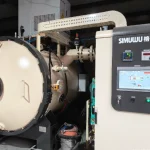
Application of RVGQ-557 Vacuum Gas Quenching Furnace—Gas Quenching and Tempering
2026-09-18
-
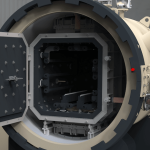
The Role and Benefits of Equipping Vacuum Furnaces with Dew Point Meters
2026-09-15
-
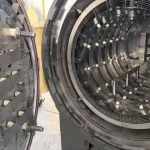
How to Bake Out a Vacuum Furnace After Shutdown? A Complete Restart Guide
2026-09-11
-
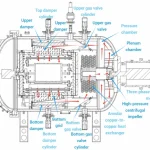
Top-and-Bottom Blast Vacuum Gas Quenching Furnace
2026-09-08
-
Vacuum Furnace Thermocouple Calibration Guide
2026-09-03