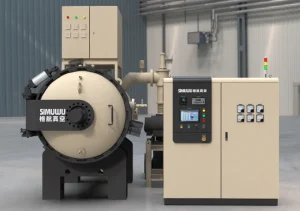
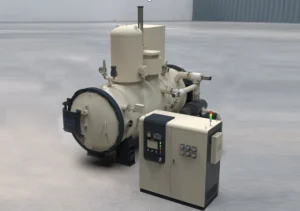
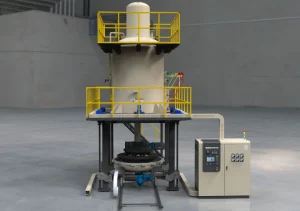
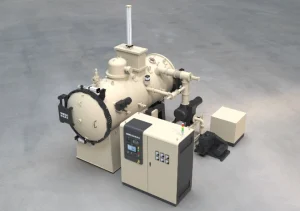
In vacuum heat treatment, the vacuum furnace heating lag time—also known as thermal hysteresis—is the critical period required for the entire workload to uniformly reach the preset temperature after the furnace elements have achieved that setpoint. Understanding and minimizing this lag is essential for optimizing thermal schedules, saving energy, preventing workpiece distortion, and ensuring consistent metallurgical quality across industrial applications.
1. Understanding Vacuum Furnace Heating Lag Time
Understanding the total heating cycle requires breaking down the process into distinct, measurable stages. The total heating time in a batch-type vacuum heat treatment furnace primarily consists of three sequential components. First, the furnace temperature rises from ambient to the set temperature, which depends heavily on the power capacity of the heating elements. Second, the vacuum furnace heating lag time occurs, where the entire load slowly absorbs radiant heat to reach a uniform internal temperature. Finally, the microstructural transformation time allows the material to undergo the necessary metallurgical changes. Engineers must focus on optimizing the lag phase because it consumes significant energy and directly impacts overall production efficiency.
2. The Physics of Heat Transfer in a Vacuum
The physical mechanism governing thermal dynamics in a vacuum environment relies almost entirely on radiation. Because convective gas flow is essentially absent and gas conduction is negligible, the Stefan-Boltzmann law dictates how workpieces absorb energy from the heating elements. Radiative power scales with the fourth power of absolute temperature (T4), meaning heat transfer remains severely limited at lower temperature ranges. Consequently, this exponential relationship causes a pronounced and unavoidable delay during the early stages of any heating cycle. Plant operators must strictly account for this physical limitation when designing thermal schedules for temperature-sensitive alloys.
3. Key Factors Influencing Heating Lag Time
3.1 Heating Temperature and Rates
Adjusting the final heating temperature and the ramp rate directly influences the severity of the thermal hysteresis. When the preset furnace temperature is higher, the thermal radiation efficiency increases exponentially, thereby accelerating the heating speed of the workpiece surface. Conversely, forcing an aggressively high heating rate at low temperatures drastically widens the thermal gradient between the surface and the core of the load. Studies show that heating 40CrMnSiMoVA steel at 920 °C drastically reduces the lag compared to holding at 870 °C. Therefore, operators should carefully balance high target temperatures with acceptable internal thermal stress to maintain component integrity.
3.2 Preheating and Multi-Stage Cycles
Implementing multi-stage heating with intermediate soaking periods serves as the most effective method to mitigate severe temperature gradients. Preheating allows the core of the workpiece to catch up with the surface temperature before the furnace ramps up to the final transformation heat. Materials with poor thermal conductivity, such as stainless steel, strictly require preheating stages around 650 °C to 700 °C to prevent irreversible distortion. By utilizing a step-heating approach, technicians systematically reduce the maximum temperature difference within the heavy payload. This methodical staging ensures metallurgical consistency while safely managing the inherent delay in radiant heating.
3.3 Load Geometry and Furnace Capacity
The physical dimensions and the internal arrangement of the workpieces dictate how efficiently they intercept thermal radiation. Large, thick-sectioned parts possess longer internal heat conduction paths, which inherently prolongs the time required for the core to reach the surface temperature. For instance, the lag time of a 50 mm diameter steel bar is approximately 40% longer than that of a 35 mm bar manufactured from the exact same material. Furthermore, dense furnace loading creates a severe heat shielding effect where outer parts physically block radiation from reaching the inner components. Engineers must consciously optimize the loading pattern and spacing to maximize radiative view factors and minimize shadow zones across the payload.
4. Methods to Determine Thermal Hysteresis
Accurately determining the thermal hysteresis interval is crucial for developing standardized and repeatable heat treatment recipes. The direct measurement method involves attaching trailing thermocouples directly to the surface and core of a test workpiece to record real-time temperature data. This practical approach is highly effective for single-chamber equipment, such as a Vacuum Annealing Furnace, ensuring precise timing for subsequent cooling phases. Alternatively, the simulation method uses computational models to predict temperature curves for varying component thicknesses, which significantly reduces the need for expensive destructive testing. For less critical applications, technicians often rely on an empirical formula by multiplying standard air furnace holding times by a factor of 1.5 to estimate the necessary vacuum cycle duration.
5. Practical Strategies to Minimize Heating Lag
Applying targeted optimization strategies significantly improves overall process efficiency and final product quality. First, implementing intelligent PID control systems prevents dangerous temperature overshoots and continuously adjusts power output based on real-time thermal feedback. Second, adopting low-thermal-mass heating elements, such as advanced graphite felt or thin metal foils, allows the furnace chamber to respond rapidly to setpoint changes. Third, computational pre-simulation enables metallurgists to digitally map out the thermal field before running physical trials, saving substantial energy and material costs. By systematically combining these advanced technologies, modern heat treatment facilities can achieve superior temperature uniformity and substantially shorter overall cycle times.
6. FAQ
What is the main cause of vacuum furnace heating lag time?
The primary cause is the strict reliance on radiative heat transfer due to the absence of convective gases. Radiation efficiency remains very low at lower temperatures, causing the solid load to heat up much slower than the low-mass furnace heating elements.
How does load density affect thermal hysteresis?
High load density creates a detrimental shadowing effect where outer components block thermal radiation from reaching the workpieces positioned in the center. This heat shielding forces the inner parts to rely on slower secondary radiation and limited physical conduction, significantly increasing the total lag.
Why is preheating necessary in vacuum heat treatment?
Preheating intentionally pauses the furnace temperature rise at specific intermediate levels, allowing the core of the workpieces to equalize with their outer surface temperatures. This crucial step prevents severe thermal gradients that could otherwise cause cracking, warping, or uneven metallurgical phase transformations.
Optimizing vacuum furnace heating lag time stands as a critical requirement for achieving high-quality, energy-efficient heat treatment cycles. By thoroughly understanding the physics of radiation, correctly configuring load geometry, and implementing strategic multi-stage preheating, engineers can eliminate excessive thermal gradients and prevent workpiece distortion. Modern manufacturing facilities increasingly rely on precise thermocouple measurements and advanced thermal modeling to continuously refine these complex heating processes. For a deeper theoretical understanding of the foundational physics behind thermal radiation, engineers can explore the MIT OpenCourseWare on Heat and Mass Transfer. If your production line requires advanced vacuum heat treatment equipment with precise temperature control, contact us today to learn more about our state-of-the-art vacuum heat treatment solutions and improve your operational efficiency.
-
RVGQ-557 vacuum gas-quenching furnace with an air-duct structure
2026-09-30
-

The Role of Nitrogen Partial Pressure in Vacuum Furnaces
2026-09-25
-
Factors Affecting the Quality of Vacuum Heat Treatment
2026-09-22
-
Application of RVGQ-557 Vacuum Gas Quenching Furnace—Gas Quenching and Tempering
2026-09-18
-
The Role and Benefits of Equipping Vacuum Furnaces with Dew Point Meters
2026-09-15