Due to the development of AI, GPU prices have increased while performance has also improved, which in turn has led to greater cooling challenges. AI servers are affected by this, so many manufacturers are paying more attention to water-cooled heat exchange plates for AI servers, resulting in a growing demand for vacuum brazing of these components.
To strike an optimal balance between superior heat dissipation and long-term reliability, the industry has developed mainstream material-based approaches:
- Copper-Stainless Steel (Dissimilar Metal Brazing): A pure copper base ensures peak heat dissipation, while a stainless steel cover provides exceptional rigidity and resistance to deformation. Formed as a single unit via high-vacuum silver-based brazing, this is currently the mainstream, high-reliability solution for high-end AI servers, offering both outstanding thermal performance and zero risk of leakage.
- All-Copper (Same-Metal Vacuum Brazing): Featuring a pure copper base paired with a pure copper cover, this design pushes thermal conductivity close to physical limits and eliminates the risk of electrochemical corrosion; it is engineered specifically for top-tier computing cores with chip power consumption reaching the kilowatt level.
- Stainless Steel-Stainless Steel (All-Stainless Steel): While offering exceptional structural strength and corrosion resistance, its thermal conductivity limitations mean it is currently primarily used for the thermal management of lower-power, secondary chips within the server.
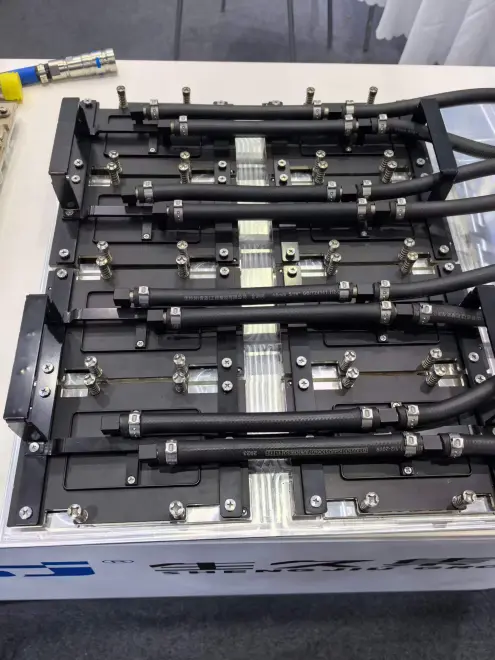
The most common copper-stainless steel liquid cooling plates typically require vacuum brazing. Fusing these two materials in a furnace at temperatures exceeding 1,000°C demands adherence to extremely rigorous conditions:
Preventing metal oxidation (a critical issue for stainless steel): Stainless steel derives its corrosion resistance from a dense chromium oxide layer on its surface. However, during high-temperature brazing, exposure to air causes rapid oxidation, preventing the braze alloy from adhering (wetting) to the surface. A vacuum environment—characterized by extremely low pressure and a near-total absence of oxygen—effectively prevents oxidation, ensuring high-quality welds.
Eliminating porosity and leakage: Liquid cooling plates for AI servers demand absolute, leak-proof sealing. In a vacuum, gases and impurities are evacuated from the weld zone, resulting in an exceptionally dense weld seam free of porosity, thereby completely eliminating the risk of future leaks.
Clean welding surfaces with no need for post-process cleaning: Vacuum brazing eliminates the need for chemical fluxes. Conventional welding methods using flux leave chemical residues within the cooling plate’s micro-channels, which can severely corrode the plate and contaminate the coolant fluid.
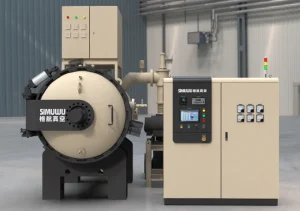
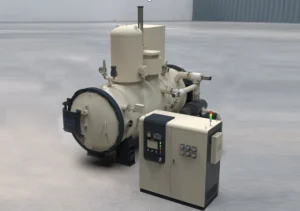
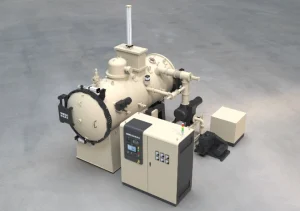
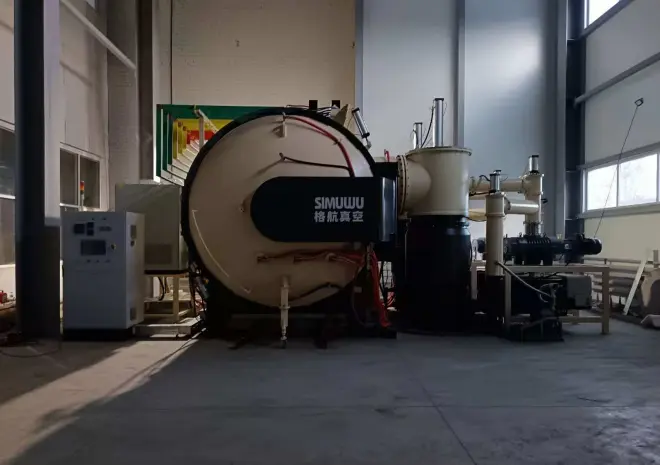
The quality of vacuum brazing is crucial to the performance of the finished product. SIMUWU’s RHVB-669H vacuum brazing furnace meets the stringent requirements for high vacuum levels and superior temperature uniformity, ensuring flawless execution of the entire process:
| Furnace Type | Horziontal,Single Chamber,Internal Cycle |
| Loading Model | Front Loading |
| Effective Working Zone Size | 600*600*900(W×H×L mm) |
| Max. Loading Weight | 500kg(Including Jig) |
| Power Supply | 3Phase 380V(±5% );50Hz |
| Max. Design Temperature | 1400℃ |
| Max. Working Temperature | 800-1300℃ |
| Temperature Uniformity | ±5℃ |
| Temperature Control Accuracy | ±1℃ |
| Heating Element | High Temperature Molybdenum |
| Heating Rate | 0~20℃ /min |
| Ultimate Vacuum | 4×10⁻³ pa |
| Pressure Rising Rate | ≤0.6Pa/h |
| Partial Pressure | 20~2000Pa(Adjustable) |
| Time for Pumping to Working Vacuum | 40min(After the pre-heating of the diffusion pump) |
| Cooling Rate | ≤40min |
Should you have any technical questions or requests, please feel free to contact kevin.liu@vacfurnace.com at any time; we are dedicated to serving you.
-
Vacuum Carburizing & Oil Quenching: Key Factors Influencing Distortion in Gear Steels
2026-10-23
-
RVGQ-7710 Vacuum Gas Quenching Furnace with Top-and-Bottom Opposing Gas Flow Structure
2026-10-20
-
Machining of Precision Automotive Components: Application of High-Pressure Vacuum Gas Quenching
2026-10-16
-
How to Enhance the Surface Brightness of Vacuum Tempered Workpieces
2026-10-13
-
Production of High-Pressure Die-Casting Molds: Application of Vacuum Gas-Quenching Furnaces
2026-10-08