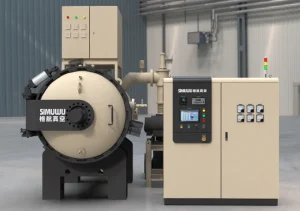
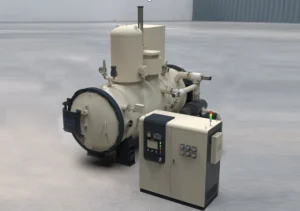
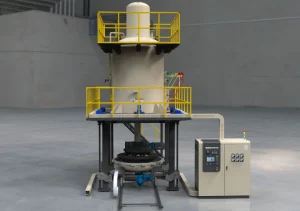
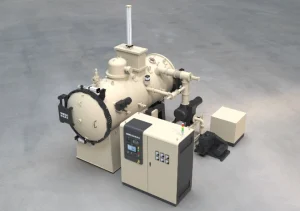
A Custom Vertical Vacuum Furnace can perform precise thermal processing under controlled atmospheric conditions. The equipment eliminates gaseous interactions to ensure bright and clean component surfaces while accommodating unique space or handling requirements. The system achieves this through optimized heating zones, vacuum pumping speeds, and cooling mechanisms tailored to specific operational needs.
1. What is a Custom Vertical Vacuum Furnace?
Understanding the fundamental mechanics of a Custom Vertical Vacuum Furnace requires defining its core orientation and atmospheric control capabilities. Unlike horizontal models, this specialized equipment aligns its hot zone upright, which naturally leverages gravity for material handling and reduces the overall factory floor footprint. Because the processing environment is entirely devoid of atmospheric gases, unwanted chemical reactions such as oxidation and decarburization are completely prevented. Consequently, engineers can achieve superior metallurgical properties in complex alloys, ensuring high-performance outcomes for critical industrial applications.
When a facility requires specific processing dimensions or unusual temperature profiles, an off-the-shelf solution is rarely sufficient. A customized approach ensures that the internal chamber geometry perfectly matches the intended workload, minimizing wasted energy and improving cycle times. By tailoring the equipment, manufacturers can easily integrate the furnace into existing automated production lines. This level of adaptability makes the vertical configuration ideal for modern smart manufacturing environments.
2. Design Principles and Customization Options
The engineering behind a successful thermal processing unit relies heavily on selecting the correct foundational architecture. Decision-makers must evaluate their specific temperature requirements, gas load expectations, and cooling speed necessities. These variables directly influence the selection of the vessel type, heating element materials, and vacuum generation equipment.
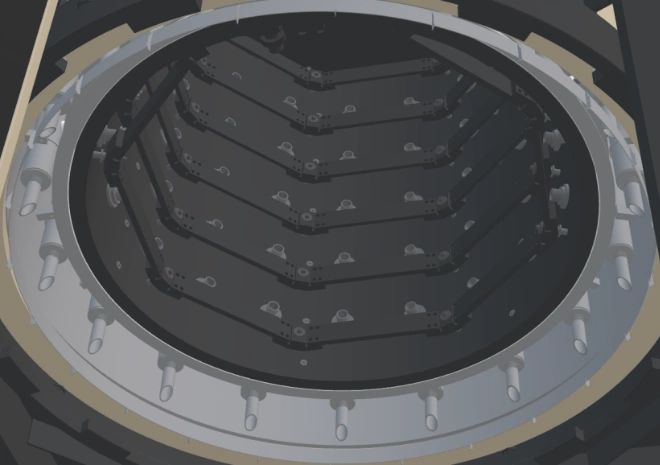
2.1 Cold-Wall vs. Hot-Retort Configurations
Choosing between a cold-wall and a hot-retort design fundamentally dictates the maximum operating temperature of the system. In a hot-retort configuration, a sealed vacuum chamber is placed inside a conventional furnace and heated externally, which typically limits operations to approximately 1100°C due to structural constraints. Conversely, the cold-wall design houses both the heating elements and thermal insulation inside the vacuum chamber, while the outer vessel is actively cooled by water. This internally heated structure allows custom designs to safely reach temperatures up to 2000°C and beyond. Therefore, the cold-wall approach is the predominant choice for high-temperature vertical applications.
2.2 Heating Elements and Radiation Shields
Selecting the appropriate hot zone construction materials is critical for long-term reliability and temperature uniformity. For industrial applications exceeding 1000°C, custom units typically utilize molybdenum, tungsten, or high-strength graphite heating elements. Graphite heaters are particularly advantageous because they maintain excellent mechanical strength at elevated temperatures, allowing for self-supporting assemblies without fragile ceramic insulators. To prevent heat loss, engineers implement highly polished radiation shields made of molybdenum or nickel-based alloys. Industry guidelines published by ASM International confirm that since no convection occurs in a vacuum, optimizing these reflective shields is essential for maximizing radiative heat transfer efficiency.
2.3 Tailored Vacuum Pumping Systems
The vacuum pumping system acts as the operational heart of the furnace, directly determining the cleanliness of the process and the speed of the cycle. A standard configuration typically involves a rotary mechanical pump acting as a primary backing pump, paired with a mechanical booster pump like a Roots blower to handle large gas loads efficiently. For highly demanding advanced thermal processing applications, vapor diffusion pumps are added to achieve ultra-high vacuum levels below 10⁻³ Torr. When customizing the system, engineers must calculate the expected outgassing rate of the specific workload to prevent pump overload. Properly sizing these components ensures rapid evacuation times and protects sensitive metallurgical surfaces from residual contamination.
3. Advantages of the Vertical Configuration
Deploying a vertical structure provides distinct logistical and operational benefits that directly impact the bottom line of manufacturing facilities. The upright orientation fundamentally changes how materials move through the thermal cycle, resulting in significant efficiency gains. These structural advantages directly address common pain points found in traditional horizontal processing.
Integrating these advantages often leads to a measurable reduction in labor intensity and energy consumption. For instance, gravity-fed automated systems minimize the duration the chamber is open to ambient conditions, thereby preserving the internal environment. Furthermore, this orientation is exceptionally well-suited for processing long, slender components that might sag or warp if placed horizontally during high-temperature cycles.
- Gravity Utilization: Raw material charging and hot residue discharge can be facilitated by gravity, reducing the need for complex mechanical conveyors.
- Space Efficiency: The upright footprint occupies significantly less valuable factory floor space compared to extended horizontal systems.
- Thermal Optimization: Symmetrical arrangement of inner heating elements promotes highly uniform radiative heat distribution across the workload.
- Automation Readiness: Vertical stacking of preheating, processing, and cooling chambers enables seamless transition into continuous or semi-continuous operations.
4. Advanced Applications of Custom Vertical Vacuum Furnaces
The versatility of these advanced thermal systems allows them to serve a wide spectrum of demanding industrial sectors. From aerospace component manufacturing to specialized automotive tooling, the precise control over atmosphere and temperature yields unparalleled material properties. Manufacturers frequently rely on these tailored systems to execute complex metallurgical recipes that are impossible in standard air furnaces.
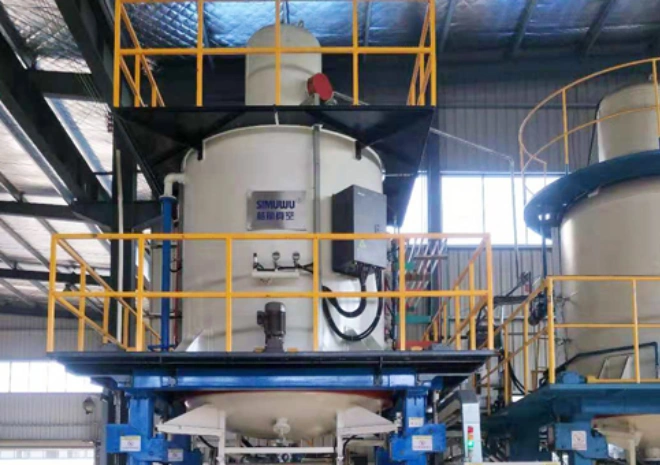
One prominent application is the heat treatment of high-alloy steels and specialized tool steels. By utilizing a Vertical Type Vacuum Gas Quenching Furnace, operators can rapidly cool components using pressurized inert gas, which minimizes physical distortion while achieving target hardness. Additionally, vacuum brazing has become critical for joining dissimilar materials, such as bonding ceramics to metals without requiring prior metallization. The ultra-clean environment ensures perfect wetting of the active brazing alloys, resulting in exceptionally strong, leak-tight joints for critical heat exchangers and medical devices.
5. FAQ
What is the primary difference between horizontal and vertical vacuum furnaces?
The fundamental difference lies in the orientation of the heating chamber, which dictates how materials are loaded and processed. Vertical models are loaded from the top or bottom, utilizing gravity for easier handling of heavy crucibles or long parts that might warp horizontally. Additionally, vertical models require significantly less horizontal floor space in a manufacturing facility.
How is temperature uniformity maintained in a vacuum?
Because convection and conduction are absent in a vacuum, heat transfer occurs exclusively through radiation. Uniformity is achieved by strategically placing heating elements symmetrically around the workload and using highly reflective radiation shields. Advanced custom designs also utilize finite element modeling to precisely adjust the distance between heating rods, compensating for radiative heat loss at the chamber boundaries.
Can a custom vertical furnace handle rapid cooling?
Yes, customized systems can integrate sophisticated cooling mechanisms to meet specific metallurgical requirements. Options include slow vacuum cooling, inert gas backfill cooling, and high-pressure forced gas circulation. Some specialized vertical designs even feature an integrated bottom-loading elevator that lowers the hot workload directly into an oil quench bath for rapid hardening.
Investing in a Custom Vertical Vacuum Furnace can enhance material processing capabilities. By tailoring the design to specific production demands, it helps improve product quality, increase energy efficiency, and strengthen competitiveness in the market. Contact our engineering team to discuss how to build a thermal processing solution aligned with manufacturing requirements.
-
Factors Affecting the Quality of Vacuum Heat Treatment
2026-09-22
-
Application of RVGQ-557 Vacuum Gas Quenching Furnace—Gas Quenching and Tempering
2026-09-18
-
The Role and Benefits of Equipping Vacuum Furnaces with Dew Point Meters
2026-09-15
-
How to Bake Out a Vacuum Furnace After Shutdown? A Complete Restart Guide
2026-09-11
-
Top-and-Bottom Blast Vacuum Gas Quenching Furnace
2026-09-08