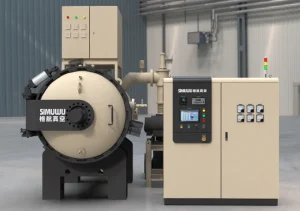
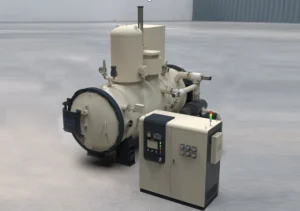
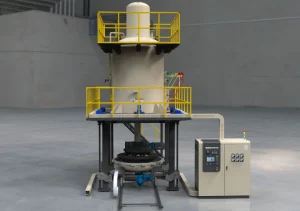
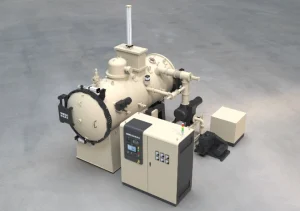
The comparison of vacuum vs atmospheric furnace environment reveals how pressure, gas composition, and chemical reactivity directly influence surface quality, process control, and material performance. While atmospheric furnaces rely on active gas management to protect or alter the metal surface, vacuum furnaces eliminate reactive gases entirely to prevent oxidation and ensure the highest levels of metallurgical purity.
1. Fundamental Environmental Differences
The core distinction in a vacuum vs atmospheric furnace environment lies in how the thermal chamber is controlled at the chemical and pressure level. This choice determines whether the heat treatment process suppresses chemical reactions or actively promotes them to modify the material surface. Understanding these differences is essential for engineers and technical managers when specifying equipment for critical industrial components.
Atmospheric furnaces operate by maintaining or introducing specific gases to shield or react with the metal, whereas a vacuum furnace operates by removing air and reactive gases to create a non-reactive environment. This fundamental split dictates everything from the final aesthetic finish of the part to its internal microstructure and dimensional stability after quenching.
2. Pressure Levels and Atmosphere Management
Pressure control is the primary mechanism used to define the vacuum vs atmospheric furnace environment. Atmospheric furnaces typically operate at or near ambient pressure (approximately 760 Torr) and use “protective” mixtures like nitrogen or argon, or “reactive” gases such as endothermic gas for carburizing. These systems require constant monitoring of dew point and gas purity to maintain consistency.
In contrast, a vacuum environment operates at pressures far below atmospheric levels, typically ranging from 10⁻² to 10⁻⁶ Torr. By removing oxygen, nitrogen, and moisture—the primary drivers of unwanted chemical reactions—the system achieves a degree of purity that gas-shielded environments cannot match.
3. Surface Integrity and Oxidation Control
Surface quality is often the deciding factor when comparing a vacuum vs atmospheric furnace environment. In an atmospheric furnace, even with high-purity inert gases, trace amounts of oxygen can lead to the formation of thin oxide scales or decarburization. These defects often necessitate post-process cleaning, such as sandblasting or acid pickling, which adds cost and risks dimensional inaccuracy.
A vacuum environment inherently eliminates the risk of oxidation. Parts processed in a Vacuum Annealing Furnace emerge with a “bright” finish, maintaining their original metallic luster. This absence of surface contamination is critical for aerospace, medical, and precision tooling applications where zero oxidation is mandatory for performance and fatigue resistance.
4. Heat Transfer Mechanisms: Radiation vs. Convection
The physical environment directly impacts how heat is transferred to the workload. In an atmospheric furnace, gas molecules facilitate convective heat transfer, which provides relatively uniform heating at lower temperatures. However, at higher temperatures, the gas can become a source of thermal instability if not circulated correctly.
In the vacuum vs atmospheric furnace environment comparison, vacuum heating relies almost exclusively on radiation. This mechanism ensures highly controlled and uniform thermal conditions at high temperatures, but it requires precise heating element placement to prevent shadowing. To maintain this precision, operators must ensure the system remains free of leaks.
5. Process Applications: Suppression vs. Promotion of Reactions
Different metallurgical objectives require different environmental strategies. Vacuum environments are preferred for processes requiring chemical neutrality, such as annealing or sintering. However, vacuum technology also enables “Low-Pressure Carburizing” (LPC) in a Vacuum Carburizing Furnace, which offers deeper penetration and better uniformity in blind holes compared to traditional gas carburizing.
Atmospheric environments are often selected for mass-produced components where controlled surface modification is the goal. For instance, traditional nitriding uses a constant flow of ammonia at atmospheric pressure. Modern alternatives like the Vacuum Nitriding Furnace provide superior control over the “white layer” thickness by pulsing gas into a vacuum, combining the benefits of both approaches.
6. Decision Framework: Choosing the Right Environment
The final decision between a vacuum vs atmospheric furnace environment hinges on balancing technical requirements with operational costs. Vacuum furnaces offer superior purity and repeatability but generally involve higher initial capital investment. Atmospheric furnaces are highly efficient for high-volume production of non-critical carbon steel parts where slight surface oxidation is acceptable.
For materials like tool steels that require extreme hardness with minimal distortion, a Dual-chamber Vacuum Oil Quenching Furnace provides the best balance of atmospheric purity and aggressive cooling. Conversely, for high-volume automotive gears, an atmospheric furnace may provide a more cost-effective solution for carbon restoration.
7. FAQ
What is the main difference between vacuum and atmospheric furnace environments?
The main difference is whether the process eliminates gases (vacuum) to prevent reactions or controls gas chemistry (atmospheric) to protect or modify the surface.
Which environment provides better surface quality?
Vacuum furnaces provide superior surface cleanliness because they remove the oxygen and moisture that cause oxidation and decarburization.
Can atmospheric furnaces prevent oxidation entirely?
Atmospheric furnaces can minimize oxidation using high-purity inert gases, but vacuum environments are fundamentally more effective at achieving zero-oxidation results.
Why are vacuum furnaces used for aerospace parts?
They ensure the high purity, repeatability, and absence of surface defects that are critical for the performance of safety-critical components.
How does gas quenching compare in these environments?
In a Vacuum Gas Quenching Furnace, high-pressure gas is introduced into the vacuum to provide uniform and rapid cooling with significantly less distortion than atmospheric quenching.
The choice of a vacuum vs atmospheric furnace environment dictates the final quality and longevity of your industrial components. By selecting the environment that best fits your metallurgical goals, you can optimize both performance and manufacturing efficiency. For authoritative technical standards on furnace atmospheres and gas-metal reactions, refer to the technical archives at ASM International. To explore advanced vacuum systems designed for precision heat treatment, visit our product catalog or contact the SIMUWU engineering team today.
-
Double Chamber Vacuum Oil Quenching Furnace with Gas Quenching Function
2026-03-26
-
Precision Vacuum Furnace Gas Flow Control Systems
2026-03-25
-
Introduction to the Vacuum Oil Quenching Carburizing Process
2026-03-24
-
Precise Methods to Measure the Wetting Angle of Metals Under Vacuum
2026-03-23
-
Vacuum Annealing Process for Inconel 718 Nickel-Based High-Temperature Alloy
2026-03-20