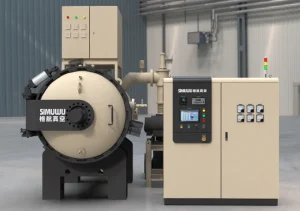
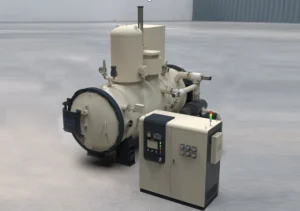
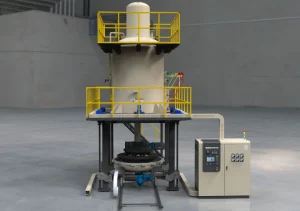
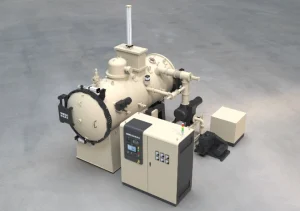
Diamond, as the hardest substance in nature, is a core material for manufacturing high-end cutting and grinding tools. However, diamond particles are brittle and need to be reliably bonded to a metal substrate to utilize their hardness advantage. Vacuum furnace brazing is one of the best solutions currently available in diamond tool manufacturing to address problems such as low bonding strength, easy oxidation, and short lifespan.
1. Core Principles of the Process
The brazing of diamond tools essentially involves using a filler material with a melting point lower than the substrate (commonly copper-nickel alloy, silver-copper alloy) to achieve a metallurgical bond between the diamond particles and the substrate (45# steel, cemented carbide, etc.) after heating and melting. Traditional air brazing, due to exposure to air, causes oxidation reactions in the substrate and filler material during heating, forming an oxide layer that hinders bonding, resulting in insufficient bonding strength and easy particle shedding; at the same time, uneven temperature distribution can easily cause thermal damage to the diamond or deformation of the substrate.
The core advantages of vacuum furnace brazing lie in “vacuum isolation” and “precise temperature control“: after vacuuming the furnace (the ultimate vacuum value can be as low as 10-4 Pa), air is completely isolated, fundamentally preventing oxidation reactions; coupled with multi-zone heating and intelligent temperature control systems, precise temperature control within the furnace can be achieved, allowing the filler material to melt evenly and fully wet the diamond surface, forming a strong metallurgical bonding layer and significantly improving tool performance.
High-performance vacuum furnaces are crucial for the successful implementation of this process. SIMUWU vacuum brazing furnaces, with years of technological accumulation, have achieved breakthroughs in core indicators such as vacuum degree, temperature control accuracy, and stability, becoming the mainstream equipment for diamond tool manufacturing companies.
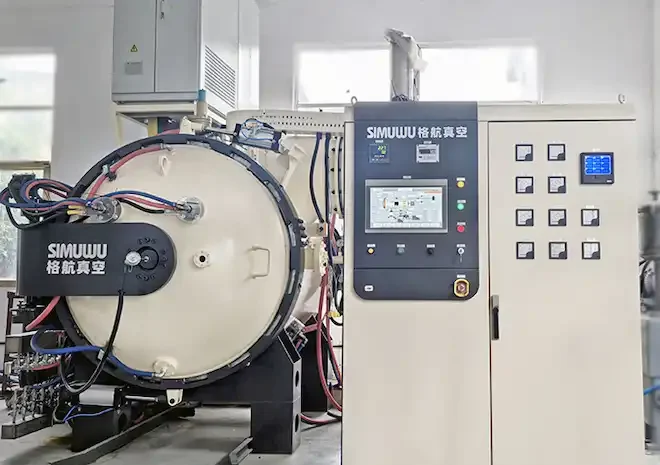
2. Vacuum Furnace Brazing Process Flow
The vacuum furnace brazing process for diamond tools requires strict control of every detail; otherwise, it can lead to bonding failure, accuracy deviations, and other problems. The following is a standardized process and key parameter requirements, which can be automated and precisely controlled using SIMUWU vacuum brazing furnaces:
2.1 Workpiece Pre-treatment
The core purpose is to remove oil stains, oxide layers, and impurities from the surface of the diamond particles and the substrate to avoid affecting the wetting effect of the filler material. Specific operation: Ultrasonic cleaning is used (cleaning time is approximately 15-20 minutes), a neutral degreasing agent is selected as the cleaning agent, and after cleaning, the workpiece is placed in a drying oven (temperature 120℃, time 30 minutes) to ensure the workpiece is dry and has low moisture content.
2.2 Brazing Filler and Diamond Arrangement
The brazing filler is selected according to the tool’s application: copper-nickel brazing filler (melting point 950-1050℃) is generally used for cutting tools, and silver-copper brazing filler (melting point 750-850℃) is generally used for grinding tools. The brazing filler thickness is controlled at 0.2-0.3mm; the diamond particles are arranged according to their application, ensuring that the particles are evenly distributed and tightly bonded to the substrate.
2.3 Vacuum Furnace Brazing Operation
Place the workpiece in the SIMUWU vacuum brazing furnace, and after closing the furnace door, perform the following steps:
● Vacuum pumping:
After reaching a certain vacuum degree, start the high-vacuum pumping system to reach the vacuum degree required by the process;
● Heating:
Heat according to the gradient heating curve, the first stage heats to 500℃ (hold for 10 minutes to remove residual water vapor), and the second stage heats to the melting point of the brazing filler (copper-nickel brazing filler heats to 1000℃, silver-copper brazing filler heats to 800℃), and the heating rate is controlled at 10℃/min;
● Holding:
Hold for 20-30 minutes to ensure that the brazing filler is fully melted and forms a metallurgical bond;
● Cooling:
Gradient cooling is used, first naturally cooling to 500℃ (hold for 15 minutes), and then forced cooling to room temperature to avoid workpiece deformation.
2.4 Post-processing and Inspection
After cooling, the workpieces are polished and deburred to ensure the flatness of the tool surface; then performance testing is conducted, with key indicators including: bonding strength, tool runout, and service life. Testing shows that workpieces processed using the SIMUWU vacuum brazing furnace have a high first-pass yield rate, exceeding the industry average.
3. Performance Comparison
SIMUWU Vacuum Furnace Brazing vs. Traditional Process. To visually demonstrate the advantages of vacuum furnace brazing, the following is a comparison of key performance parameters between SIMUWU vacuum furnace brazing and traditional air brazing.
| Compared Items | Traditional Air Brazing | SIMUWU Vacuum Furnace Brazing |
| Ultimate vacuum value | None (Air environment) | 6.7×10⁻⁴ Pa |
| Temperature difference inside the furnace | ±8-10℃ | Within ±5℃ |
| Bonding strength | 180-220 MPa | 220-280 MPa |
| Diamond thermal damage rate | 15%-20% | ≤8%-10% |
| Average tool lifespan | 80-120 hours | 180-200 hours |
| Cutting accuracy deviation | ≥0.05 mm | ≤0.04 mm |
| Production pass rate | Approximately 88% | Over 95% |
| Production efficiency per batch | 20-30 pieces/8 hours | Customizable |
4. Core Enabling Advantages of SIMUWU Vacuum Furnaces
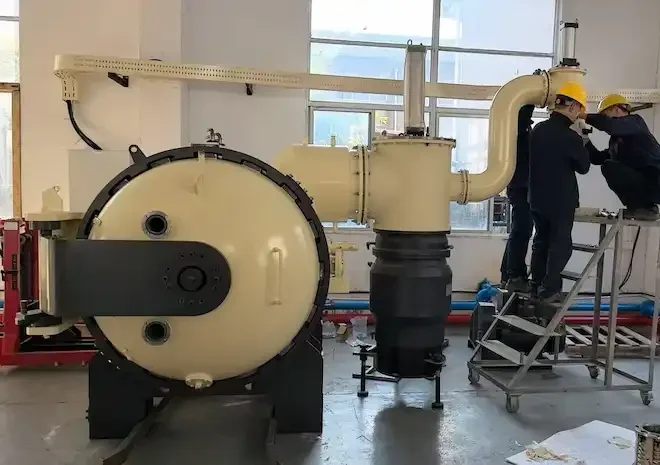
SIMUWU vacuum brazing furnaces significantly improve the processing quality and production efficiency of diamond tools. Their core advantages include:
4.1 Precise Temperature Control and Efficient Vacuum Pumping
Equipped with a partitioned independent heating system and high-precision temperature sensors from internationally renowned brands, the furnace monitors the internal temperature in real time, maintaining a temperature difference within ±5℃, preventing thermal damage to the diamond and deformation of the substrate. A three-stage pumping system achieves the ultimate vacuum value within 40 minutes, quickly removing volatile substances from the furnace and preventing impurity residue.
4.2 Stable, Reliable, and Energy-Efficient
The equipment uses high-quality insulation materials and a sealed structure, ensuring stable vacuum levels; the heating system employs an energy-saving design, reducing energy consumption by 25% compared to ordinary vacuum furnaces, significantly lowering production costs for businesses in the long term.
4.3 Strong Adaptability and Intelligent Operation
It is compatible with various specifications and types of diamond tools (saw blades, grinding wheels, drill bits, etc.), supporting customized process parameter settings; equipped with a touch screen control system, it allows for pre-setting heating, holding, and cooling curves, enabling automated production without frequent manual intervention, thus lowering the operating threshold.
5. Application Scenarios and Practical Results
Currently, SIMUWU vacuum brazing furnaces are widely used in construction, aerospace, new energy, mechanical processing, and other fields,
such as granite cutting saw blades, titanium alloy parts grinding wheels, and diamond tools for battery tray processing.
6. Process Precautions and Summary
6.1 Key precautions for vacuum brazing
● Thorough pre-treatment is necessary to avoid oil stains and impurity residue;
● The thickness of the brazing material and the arrangement of diamonds must be precise, otherwise it will affect the bonding effect;
● Strictly follow the gradient heating and cooling curves to avoid workpiece deformation caused by rapid cooling;
● Regularly check the vacuum furnace’s sealing performance and heating system to ensure stable equipment operation.
6.2 Summary
Vacuum brazing is a core process for improving the performance of diamond tools, and the SIMUWU vacuum brazing furnace, with its advantages of precise temperature control, high efficiency, energy saving, and stability, provides strong support for the implementation of this process. High-temperature vacuum brazing furnaces can not only improve the bonding strength, service life, and processing accuracy of diamond tools, but also reduce production costs and increase production capacity for businesses, driving the diamond tool industry towards “high precision, long lifespan, and large-scale production.” In the future, with continuous technological optimization, SIMUWU will further improve its vacuum furnace brazing process to adapt to more high-end manufacturing scenarios, injecting new impetus into the industry’s technological upgrading.For detailed technical information, please click here to learn more about the High Temperature Vacuum Brazing Furnace.
If you want to know more about vacuum furnace equipment, please send your needs, and our company will give you a satisfactory solution.
-
The Difference Between Solution and Anneal in Heat Treatment
2026-03-04
-
How Vacuum Levels Are Measured: Vacuum Gauge and Sensors
2026-03-02
-

Operation & Maintenance of Industrial Vacuum Furnaces
2026-02-28
-
The role of magnesium getters in vacuum aluminum brazing stability
2026-02-27
-
Application of vacuum sintering furnace in titanium alloy
2026-02-26