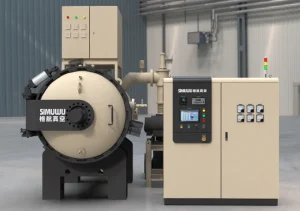
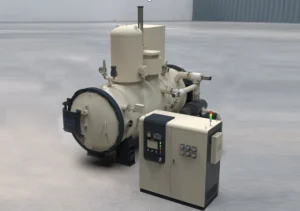
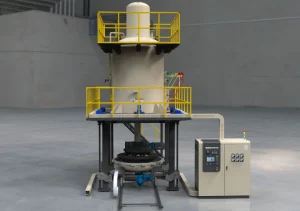
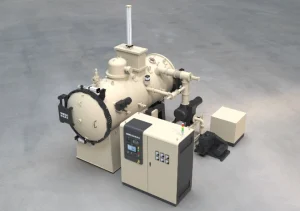
Partial pressure control in high-temperature vacuum sintering is a sophisticated materials processing strategy that enables the precise manipulation of sintering atmospheres. By regulating the concentration of specific gaseous species within a vacuum environment, engineers can achieve targeted material properties while preventing unwanted defects. This technology is essential for the production of advanced ceramics, intermetallics, and reactive metals where stoichiometry and surface integrity are paramount.
1. Fundamental Principles of Partial Pressure Control
Partial pressure control involves maintaining a specific gaseous environment even when the total pressure is significantly below atmospheric levels. In a Vacuum Sintering Furnace, this is achieved by introducing a controlled leak of high-purity process gases—such as Argon, Nitrogen, or Hydrogen—while the vacuum pumps continue to operate.
This dynamic balance between gas inflow and evacuation allows for the regulation of the “partial pressure” of individual components. For example, if a process requires an environment free of oxygen but needs a small amount of nitrogen to prevent the dissociation of a nitride ceramic, partial pressure control provides the solution. This method is far more precise than simple “dead-end” backfilling, as it allows for the continuous removal of outgassing products and contaminants.
2. Why Partial Pressure Control in High-Temperature Vacuum Sintering is Necessary
Maintaining a pure vacuum is not always ideal for every material; in many cases, a controlled atmosphere is required to manage chemical stability and mass transport.
2.1 Suppressing Evaporation and Dissociation
At high temperatures, certain elements or compounds within a material may have a high vapor pressure, leading to unwanted evaporation or thermal dissociation. By applying partial pressure control in high-temperature vacuum sintering, manufacturers can introduce an inert gas to increase the local pressure at the material surface. This suppresses the loss of volatile components, ensuring the final part maintains its designed chemical composition.
2.2 Managing Oxidation and Reduction Reactions
For reactive metals, even trace amounts of oxygen can be detrimental. Controlled partial pressures of reducing gases, such as hydrogen, can be used to “scavenge” residual oxygen or reduce existing surface oxides during the heating phase. Conversely, in oxide ceramics, a specific oxygen partial pressure might be necessary to maintain stoichiometry and electrical properties. This level of environmental precision is a key factor in the Vacuum vs. Conventional Heat Treatment Comparison.
3. Key Applications and Material Systems
The ability to fine-tune the sintering atmosphere has expanded the capabilities of powder metallurgy and technical ceramics.
- Intermetallic Compounds: For Fe-Al intermetallics, oxygen partial pressure must be strictly managed to prevent brittle oxide formation. Research indicates that specific vacuum levels (e.g., 3 mbar) produce compacts with superior density and mechanical strength.
- Advanced Ceramics: Non-oxide ceramics like Silicon Carbide processed in a SIC Vacuum Sintering Furnace require precise atmosphere control to prevent the decomposition of the Si-C bond.
- Refractory Metals: Tungsten and Molybdenum sintering cycles benefit from partial pressure control to remove interstitial impurities that would otherwise cause embrittlement. This is a critical step in the Vacuum Sintering Process for Tungsten Carbide (Cemented Carbide).
4. Implementation via Advanced Control Systems
Achieving repeatable results requires high-accuracy hardware and integrated software. Modern Vacuum Resistance Sintering Furnaces utilize closed-loop feedback systems to maintain atmosphere stability.
4.1 Mass Flow and Pressure Monitoring
Systems utilize Thermal Mass Flow Controllers (MFCs) to meter process gases with milliliter-level precision. These are paired with wide-range vacuum gauges and capacitance manometers that provide pressure readings independent of gas type. By integrating these sensors, Advanced Vacuum Control Systems can adjust gas flow in real-time to compensate for furnace outgassing or temperature fluctuations.
4.2 Leak Rate Management
A low system leak rate is the foundation of effective partial pressure control. If a furnace has a high leak rate, atmospheric oxygen will overwhelm the controlled process gas, leading to contamination. For technical details on maintaining these standards, refer to our guide on Vacuum Level, Leak Rate, and Control in Vacuum Furnaces.
5. FAQ
Q: What is the difference between partial pressure and total pressure?
A: Total pressure is the sum of the pressures of all gases in the chamber. Partial pressure is the pressure contributed by a single specific gas (e.g., the partial pressure of Oxygen). In vacuum sintering, we often care more about the partial pressure of reactive gases than the total vacuum level.
Q: Can partial pressure control be used for debinding?
A: Yes. In a Vacuum Dewaxing & Sintering Furnace, a small partial pressure of carrier gas is used to “sweep” evaporated binders out of the hot zone, preventing them from condensing on the furnace walls or heating elements.
Q: How does partial pressure affect grain growth?
A: By controlling the atmosphere, you can influence the surface energy of the particles. Certain gas partial pressures can inhibit surface diffusion while promoting volume diffusion, leading to high density with minimal grain growth.
Q: Can partial pressure control be used for debinding?
A: Yes. In a Vacuum Dewaxing & Sintering Furnace, a small partial pressure of carrier gas is used to “sweep” evaporated binders out of the hot zone, preventing them from condensing on the furnace walls or heating elements.
Q: How does partial pressure affect grain growth?
A: By controlling the atmosphere, you can influence the surface energy of the particles. Certain gas partial pressures can inhibit surface diffusion while promoting volume diffusion, leading to high density with minimal grain growth.
Mastering partial pressure control in high-temperature vacuum sintering allows manufacturers to push the boundaries of material performance. Whether you are working with reactive alloys or complex ceramics, the ability to define your atmosphere is the key to consistent, high-quality results. For a deeper scientific analysis of gas-solid interactions during sintering, we recommend reviewing the technical papers hosted on Scientific.net (Applied Mechanics and Materials).
Are you looking to optimize the sintering parameters for a new material? Contact our technical team today to discuss how our Vacuum Heat Treatment Furnace solutions can improve your production yield.
-
Vacuum Brazing Joint Quality: Dynamics & Design
2026-04-03
-
Important Applications of Low-Temperature Vacuum Aluminum Brazing Furnace
2026-04-02
-
40Cr Vacuum Oil Quenching Process
2026-03-31
-
Comprehensive Guide to Industrial Furnace Classification
2026-03-30
-
Vacuum vs Atmospheric Furnace Environment Comparison
2026-03-27