In industrial metallurgy, selecting the correct heat treatment is the boundary between a high-performance component and a costly failure. While “annealing” and “solution annealing” (or solution treatment) are often mentioned in the same breath, they serve distinct metallurgical objectives.
The primary difference lies in their cooling strategies: annealing focuses on slow cooling to soften materials, while solution treatment relies on rapid quenching to homogenize the alloy’s structure.
1. Annealing: Softening for Workability
Annealing is a primary heat treatment used to increase ductility and reduce hardness, primarily in carbon steels. The process involves heating the material to a temperature approximately 30°C to 50°C above the upper transformation temperature (A₃).
- The Objective: To create a more workable material by relieving internal stresses and refining grain structures.
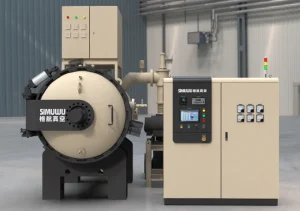
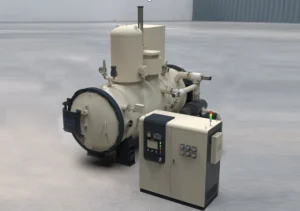
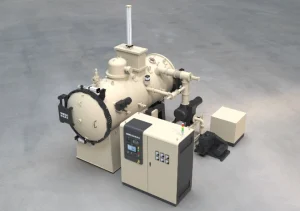
- The Cooling Strategy: The defining characteristic of annealing is its slow, controlled cooling rate—typically 55°C/hr or below. This often occurs within a [Vacuum Annealing Furnace] to prevent surface oxidation and decarburization.
- The Result: A coarse pearlitic or spheroidized structure that is easy to machine or cold-work.
2. Solution Treatment: Homogenization for Strength
Solution treatment, often called solution annealing, is designed to dissolve alloying elements into a single solid phase. This is most commonly applied to stainless steels, aluminum alloys, and nickel-based superalloys.
- The Objective: To dissolve precipitates and second phases into a homogeneous solid solution. In stainless steels, this is critical for preventing “sensitization”—the depletion of chromium at grain boundaries that leads to intergranular corrosion.
- The Cooling Strategy: Unlike standard annealing, solution treatment requires rapid cooling (quenching). This “freezes” the dissolved alloying elements in place, creating a supersaturated solid solution at room temperature.
- The Result: Improved corrosion resistance and a prepared state for subsequent precipitation or age hardening steps.
3. Key Technical Comparison
| Feature | Annealing (Standard) | Solution Annealing |
| Primary Goal | Softening and Stress Relief | Homogenization and Corrosion Resistance |
| Cooling Method | Slow furnace cooling | Rapid quenching (Water/Gas) |
| Microstructure | Stable, coarse grains | Supersaturated solid solution |
| Common Materials | Carbon steels, low-alloy steels | Stainless steel, Aluminum, Superalloys |
4. Why Equipment Precision Matters
Whether your application requires the ductility of standard annealing or the specialized corrosion resistance of solution treatment, the stability of the thermal cycle is paramount.
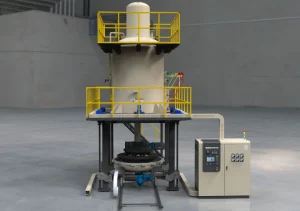
In [Vacuum Heat Treatment], even minor temperature fluctuations can lead to inconsistent grain growth or incomplete dissolution of phases. Modern systems utilize advanced thermocouple feedback and programmed cooling ramps to ensure that the transition—whether it is a slow 55°C/hr drop or a high-pressure gas quench—is executed with mathematical precision.
Ensuring accurate monitoring through proper vacuum measurement technology is necessary to maintain the inert environment required for these high-temperature cycles.
5. Comparing Temperature, Soaking, and Cooling Rates
To choose the process of solution or anneal heat treatment, one must consider the material composition and the desired mechanical properties. The following table highlights the technical variations:
| Parameter | Standard Annealing | Solution Annealing |
|---|---|---|
| Target Materials | Carbon Steels, Copper, Brass | Stainless Steels, Nickel Alloys |
| Heating Temp | 30–50°C above A3 (Variable) | 1000°C – 1150°C |
| Soaking Time | Approx. 2.4 min/mm thickness | Sufficient for full solutionizing |
| Cooling Method | Very Slow (≤55°C/hr) in furnace | Rapid Quenching (Water/Gas) |
| Main Result | Ductility, Refined Grains | Corrosion Resistance, Solutionizing |
6. FAQ
Q: Can all alloys benefit from solution treatment?
No. It is applicable mainly to precipitation-hardenable alloys. Alloys lacking a suitable solvus region may not show improved properties from this treatment.
Q: Does solution annealing make a material harder?
Generally, it reduces the hardness of work-hardened stainless steel, making it more ductile (similar to annealing), but its primary purpose remains chemical homogenization rather than just softening.
Q: What happens if I cool a solution treatment too slowly?
The alloying elements will re-precipitate at the grain boundaries, which can significantly reduce the material’s corrosion resistance and mechanical toughness.
Conclusion
Understanding the technical nuances between solution vs. anneal heat treatment ensures process reliability in high-stakes manufacturing. SIMUWU integrates Siemens PLCs and Eurotherm controllers into our automated equipment to ensure precision control up to 1300°C. [Contact us] to learn more about our vacuum furnace solutions featuring Leybold pumps and high-performance sensor options.
-
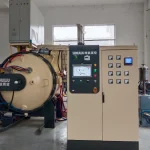
How Vacuum Levels Are Measured: Vacuum Gauge and Sensors
2026-03-02
-

Operation & Maintenance of Industrial Vacuum Furnaces
2026-02-28
-
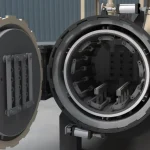
The role of magnesium getters in vacuum aluminum brazing stability
2026-02-27
-
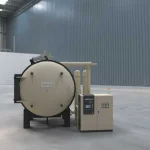
Application of vacuum sintering furnace in titanium alloy
2026-02-26
-
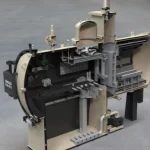
Vacuum Level, Leak Rate, and Control in Vacuum Furnaces
2026-02-25