1. Material Characteristics
S20C is a low-carbon steel (equivalent to Chinese 20# steel or American AISI 1020), commonly used in the manufacture of carburized gears. Due to its low carbon content (0.17-0.23%), direct quenching cannot achieve high hardness. Carburizing treatment is necessary to increase the surface carbon content before quenching to obtain the desired “hard surface and tough core” properties. This material has high cold deformation plasticity and good weldability, and is mainly used in the manufacture of mechanical parts that are subjected to relatively low stress but require high toughness, such as automotive gearbox shift forks and agricultural machinery camshafts.
2. Advantages of Vacuum Oil Quenching
For S20C gears (especially precision gears), choosing a vacuum oil quenching furnace offers significant advantages compared to traditional pit-type gas carburizing furnaces:
1. Excellent Surface Quality (No Oxidation, No Decarburization)
Bright Surface: The vacuum environment is an oxygen-free environment. S20C gears will not oxidize or decarburize during heating and cooling, resulting in a bright, silvery-gray surface after treatment. SIMUWU vacuum oil quenching and carburizing furnaces can achieve an ultimate vacuum of 6.7*10-1Pa, providing a good vacuum and resulting in superior surface quality of the workpiece.
Reduced Process Steps: Unlike traditional processes, sandblasting or pickling to remove scale is not required, and the parts can even be directly precision ground or assembled, significantly saving on subsequent cleaning costs.
2. Minimal Deformation (High Dimensional Accuracy)
Uniform Heating: Vacuum heating mainly relies on radiation, resulting in slow and uniform heating. SIMUWU’s vacuum furnaces comply with the AMS2750H standard, and the furnace temperature uniformity can reach ±5℃, resulting in small temperature differences and low thermal stress in different parts of the gear.
Vertical Oil Immersion: Vacuum furnaces typically use a vertical suspension method for oil immersion, eliminating deformation caused by gravity (such as bending). In addition, SIMUWU vacuum oil quenching furnaces control the workpiece transfer time to within 25 seconds, minimizing uncontrollable time and allowing the workpiece to enter the oil with as uniform a temperature as possible, thus achieving “simultaneous” cooling and significantly reducing deformation. Results: The gears exhibited minimal deformation after quenching, significantly reducing the scrap rate and the need for grinding.
3. High-Quality Carburized Layer
No internal oxidation: Traditional gas carburizing easily causes “internal oxidation” at grain boundaries, leading to a decrease in gear fatigue strength. Vacuum carburizing completely avoids this problem, improving the contact fatigue life and bending fatigue life of the gears.
Precise control: Vacuum carburizing allows for precise control of carbon potential, preventing the precipitation of “network carbides” caused by excessively high surface carbon concentration, which is crucial for preventing brittle fracture of gears.
4. Environmental Protection and Safety
No exhaust gas: Vacuum carburizing uses pure carburizing gas and is carried out in a sealed furnace, eliminating the toxic exhaust gases (such as CO and carbon black smoke) emitted by traditional carburizing furnaces.
Long oil life: The vacuum oil tank is sealed, and the quenching oil does not come into contact with air, preventing oxidation and deterioration, resulting in a service life several times longer than ordinary quenching oil.
5. Suitable for Complex Shapes
S20C is often used to manufacture gears with complex shapes. Although the cooling capacity of vacuum oil quenching is weaker than water quenching, by adjusting the oil temperature, stirring speed, and oil tank pressure, the hardenability requirements of S20C (after carburizing) can be met, while avoiding the significant risk of cracking caused by water quenching.
3. Vacuum Carburizing and Oil Quenching Steps
1. Pre-cleaning:
Clean the gears before entering the furnace to remove surface oil, cutting fluid, and metal chips, preventing contamination of the graphite heating elements and insulation screens in the vacuum furnace.
2. Heating and Carburizing:
The furnace is evacuated to a vacuum state and heated to the carburizing temperature (usually around 950°C).
Carburizing gas (such as acetylene C2H2) is introduced. In a vacuum environment, gas molecules have a long mean free path and high reactivity, resulting in a faster carburizing speed than traditional gas carburizing. Precise control of surface carbon concentration and effective hardened layer depth is achieved.
3. Diffusion and Cooling:
After carburizing, the temperature is maintained for diffusion to create a more reasonable carbon concentration gradient.
Then, the temperature is lowered to the quenching temperature (usually around 850°C).
4. Vacuum Oil Quenching:
The gears are quickly transferred to a vacuum oil tank for quenching. Key parameters: Oil temperature is usually controlled at around 100°C.
Stirring speed: High-speed stirring to ensure uniform cooling.
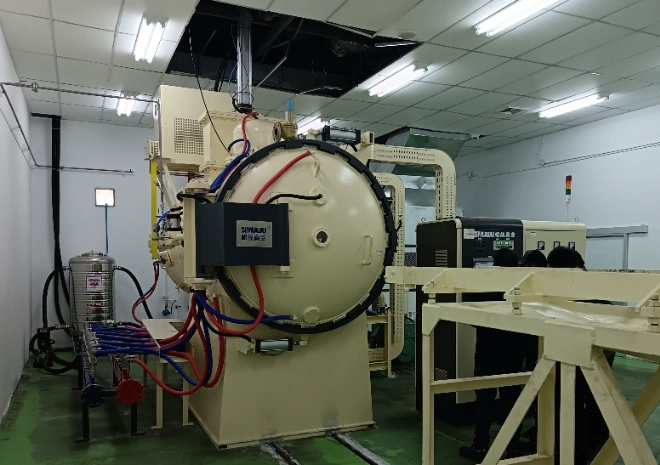
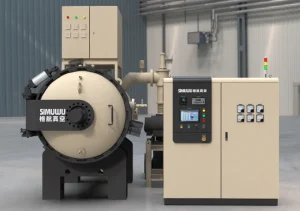
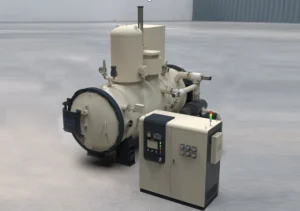
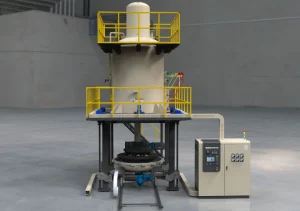
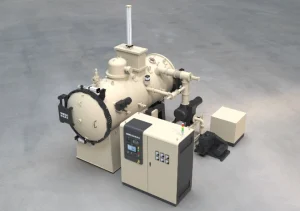
SIMUWU’s VQGQ series vacuum oil quenching furnace is a high-quality product for vacuum heat treatment processes of materials such as carbon steel, tool steel, mold steel, high-speed steel, and ultra-high-strength steel. Excellent temperature control accuracy and uniformity ensure the effective vacuum quenching process. SIMUWU focuses on the manufacturing of vacuum furnaces and has more than ten years of relevant experience, enjoying a good reputation in the field of vacuum furnace manufacturing. The product line includes vacuum gas quenching furnaces, vacuum oil quenching furnaces, and vacuum brazing furnaces, which are widely sold to developed and developing countries. For detailed technical information, please click the website below:
If you would like to learn more about vacuum furnace equipment, please send your requirements to kevin.liu@vacfurnace.com, and our company will provide you with a satisfactory solution.
-
Vacuum hardening(Quenching) process for SS420 stainless steel cutting tools
2026-01-22
-
Application of vacuum quenching furnaces on 40Cr steel
2026-01-20
-
Application of vacuum oil quenching furnace on 1.2550
2026-01-13
-
Vacuum Brazing Process for Diamond Tools
2026-01-08
-
How to process 1.2344 using a vacuum quenching furnace
2026-01-05