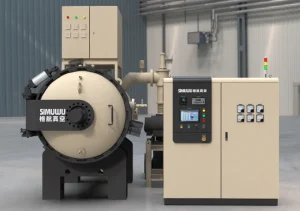
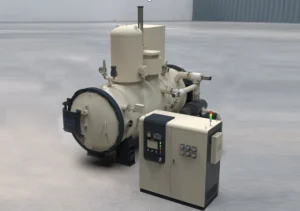
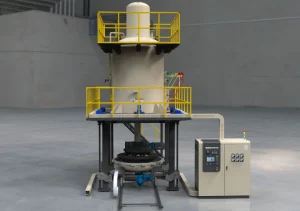
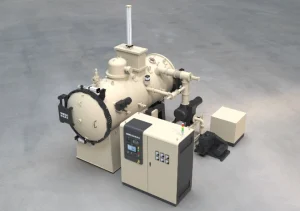
To precisely measure the wetting angle of metals under vacuum, engineers rely on specialized instrumentation and high-temperature optical analysis to obtain reliable contact angle data for metal–substrate systems. Understanding these wetting characteristics is essential for optimizing joint strength, ensuring material compatibility, and refining the parameters of industrial thermal processing. In advanced vacuum metallurgy, the interface between liquid and solid phases determines the success of critical processes like brazing and sintering.
1. Definition and Industrial Relevance
The wetting angle, or contact angle, provides a quantitative measure of the “wettability” of a solid surface by a liquid metal. It directly reflects the interfacial energy balance and determines how a molten metal interacts with a solid substrate. This parameter is critical in manufacturing processes such as brazing, soldering, coating adhesion, and metal infiltration into porous structures.
High-performance applications require low contact angles (typically less than 90°) to ensure the filler metal effectively spreads and fills joint clearances. By choosing to measure the wetting angle of metals under vacuum conditions, technicians can simulate actual production environments while accounting for oxide dissociation and atmospheric purity. This accurate data prevents risks such as incomplete bonding or poor interface adhesion in the final metallurgical bond.
2. Core Principles of Vacuum Wetting
The wetting angle is governed by the interfacial energy equilibrium at the triple line where the solid, liquid, and vapor phases meet. This balance is mathematically described by Young’s Equation, which considers solid–vapor energy, solid–liquid energy, and liquid–vapor energy. The resulting equilibrium defines the contact angle and dictates the spreading behavior of molten metal droplets.
In a vacuum environment, this measurement becomes a critical indicator of surface cleanliness and chemical reactivity. The absence of atmospheric gases allows for the direct observation of how interfacial energy changes without interference from oxidation. This fundamental equilibrium is the basis for determining if a system is “wetting” (below 90°) or “non-wetting” (above 90°).
3. The Sessile Drop Method: The Industrial Standard
The sessile drop technique is the most widely utilized method to measure the wetting angle of metals under vacuum due to its ability to handle extreme temperatures. This process involves placing a small piece of metal penetrant onto a flat substrate and heating the assembly until the metal melts to form a droplet. Once the droplet reaches equilibrium, high-resolution cameras capture the profile of the liquid-solid interface for analysis.
This method is preferred because it provides direct visualization of the droplet shape, allowing for the simultaneous calculation of both the contact angle and surface energy. Furthermore, the sessile drop approach is highly adaptable to various metal–substrate systems, making it the “gold standard” for advanced metallurgical research.
4. Equipment Configuration for Vacuum Wetting Analysis
Reliable analysis requires a sophisticated integration of vacuum, thermal, and optical systems to maintain a high degree of control.
- High-Vacuum Chamber: The chamber must reach ultra-high vacuum (UHV) levels, typically between 10⁻⁵ and 10⁻⁷ mbar. This environment suppresses oxidation and prevents atmospheric oxygen from artificially increasing the wetting angle.
- Heating System: Systems must be capable of reaching melting points exceeding 1500°C, and sometimes up to 2000°C depending on the alloy. This precision is similar to the standards used in a Vacuum Sintering Furnace.
- Optical Imaging and Backlight: High-resolution cameras paired with monochromatic backlighting create a sharp silhouette of the droplet. Telecentric lenses are used to minimize parallax errors and ensure accurate contour detection from a distance.
- Vacuum-Rated Viewports: Specialized quartz or sapphire windows allow optical access while maintaining the vacuum integrity and thermal stability of the furnace.
5. Step-by-Step Guide to Measure the Wetting Angle of Metals Under Vacuum
Achieving accurate results requires following a defined sequence of preparation and execution.
- Surface Preparation: Both the metal sample and substrate must be polished to a mirror finish and ultrasonically cleaned. Surface roughness can cause “contact angle hysteresis,” where the liquid becomes pinned on irregularities.
- Evacuation: Load the sample and evacuate the chamber to the target pressure. Proper monitoring is essential; for details, see How Vacuum Levels Are Measured: Vacuum Gauge and Sensors.
- Controlled Heating: Raise the temperature at a steady rate to reach the liquidus point. Avoid rapid heating to prevent outgassing bursts that could disturb the droplet shape.
- Droplet Formation and Capture: Once the metal melts and forms a droplet, capture a series of high-resolution images. The droplet must reach equilibrium, as the angle often evolves over time due to reactions and diffusion.
- Analysis and Cooling: Use software to calculate the angle from the captured profile. After the test, the solidified droplet can be cross-sectioned to inspect for chemical reactions or diffusion zones.
6. Data Analysis and Mathematical Modeling
The accuracy of the measurement depends heavily on the analysis method applied to the captured droplet profile.
| Analysis Method | Description | Application |
|---|---|---|
| Tangent Method | Direct angle measurement at the triple line. | Quick, manual estimations. |
| Young–Laplace Fitting | Applies a mathematical model to define the full droplet shape. | High-accuracy scientific research. |
| ADSA | Axisymmetric Drop Shape Analysis for automated detection. | Precision industrial testing. |
The Young-Laplace equation (ΔP = γ (1/R1 + 1/R2)) ensures that even if a droplet deforms at high temperatures, the resulting angle remains scientifically accurate. Laser-based and optical goniometry can further reduce reading errors to within ±0.2° in optimized systems.
7. Critical Variables and Error Control
Several parameters directly influence measurement accuracy and must be mitigated through best practices. Temperature is a dominant factor, as the contact angle is temperature-dependent due to changes in surface tension and reaction kinetics. Additionally, the “leak rate” of the chamber is a significant variable; even a minor leak can introduce enough oxygen to alter the liquid metal’s surface tension. Management of these variables is discussed in Vacuum Level, Leak Rate, and Control in Vacuum Furnaces.
Trace elements also play a role; for example, magnesium getters are vital in aluminum joining to break down stable oxides. We emphasize the role of magnesium getters in vacuum aluminum brazing stability to ensure experiment repeatability. Engineers should perform multiple measurements and average the results to account for surface heterogeneity.
8. FAQ
Q: What is a “good” wetting angle for brazing?
A: For effective results in a High Temperature Vacuum Brazing Furnace, a contact angle of less than 30° is ideal for excellent capillary flow.
Q: How does vacuum level affect the measured angle?
A: A deeper vacuum removes surface contaminants and facilitates the dissociation of oxide layers, typically leading to a lower (better) wetting angle.
Q: Can the contact angle exceed 90° in metals?
A: Yes. Non-wetting systems, such as molten metals on certain carbon substrates, often show angles above 120°.
Q: Why measure both advancing and receding angles?
A: These measurements quantify hysteresis and reveal surface heterogeneity and dynamic wetting behavior.
Q: Why is the sessile drop method preferred over others?
A: It allows for direct visualization of the droplet and calculation of both contact angle and surface energy in one step.
-
Vacuum vs Atmospheric Furnace Environment Comparison
2026-03-27
-
Double Chamber Vacuum Oil Quenching Furnace with Gas Quenching Function
2026-03-26
-
Precision Vacuum Furnace Gas Flow Control Systems
2026-03-25
-
Introduction to the Vacuum Oil Quenching Carburizing Process
2026-03-24
-
Vacuum Annealing Process for Inconel 718 Nickel-Based High-Temperature Alloy
2026-03-20