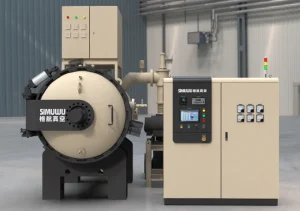
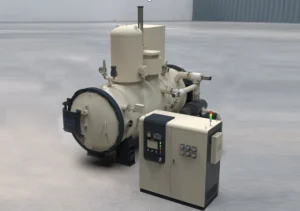
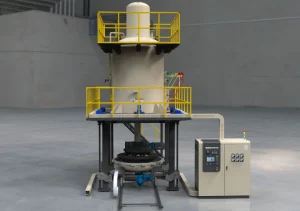
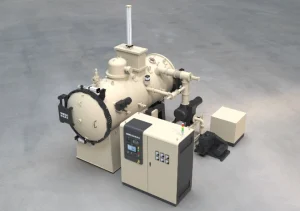
Vacuum oil quenching carburizing is an advanced heat treatment process in which carburization is performed within a low-pressure vacuum environment. Utilizing high-purity hydrocarbon gases as the carburizing medium, the core of this gas carburizing technology involves a pulsed gas supply method that facilitates the diffusion of carbon atoms into the surface of metal workpieces, followed by rapid oil quenching. Its key advantages include the absence of oxidation, uniform carburized layers, minimal deformation, and high surface quality; consequently, it is widely applied to precision components subjected to heavy loads.
I. Core Process Principles
- Vacuum Environment: The furnace chamber is evacuated to a low-pressure range of 10-1 to 10-3 Pa, completely isolating oxygen and thereby eliminating oxidation, decarburization, and intergranular oxidation (IGO).
- Carburization Mechanism: At high temperatures (920–1050°C), carburizing gases—such as acetylene or propane—are introduced; these gases thermally decompose to generate active carbon atoms, which are adsorbed onto the steel surface and subsequently diffuse inward to form a high-carbon carburized layer.
- Pulsed Carburization: Typically employs an alternating “boost–diffuse” cycle to precisely control the carbon concentration gradient and the depth of the carburized layer.
- Oil Quenching and Hardening: Following carburization, the workpiece is rapidly immersed in vacuum quenching oil, causing the high-carbon surface structure to transform into martensite, thereby achieving high hardness and wear resistance.
II. Standard Process Flow (Illustrated using Gears)
Furnace Loading and Vacuum Degreasing
Workpieces are loaded into the furnace → Vacuum is drawn to ≤10 Pa → Temperature is raised to 300–450°C and held to remove surface oil residues and adsorbed gases.
Heating and Equalization
Under vacuum, the temperature is raised to the specific carburizing temperature (e.g., 930°C) and held to ensure uniform temperature distribution throughout the workpieces and complete austenitization of the microstructure.
Vacuum Carburizing (Pulsed Cycle)
- Boost Phase: Acetylene gas is introduced, raising the furnace pressure to 0.1–1 mbar, allowing active carbon to rapidly saturate the surface.
- Diffuse Phase: The gas supply is halted and the vacuum is drawn down; carbon atoms then diffuse inward to control the gradient of the carburized layer.
This cycle is repeated until the target carburized layer depth (e.g., 0.6–1.2 mm) is achieved.
Cooling and Equalization (Preparation for Quenching)
Upon completion of carburization, the temperature is lowered under vacuum to the specific quenching temperature (e.g., 830–850°C) and held to ensure thermal equalization. Vacuum Oil Quenching
Rapid transfer to an inert-gas-filled quenching chamber, followed by immersion in quenching oil heated to 60–100°C; cooling is facilitated by agitation to complete the martensitic phase transformation.
Low-Temperature Tempering
Following oil quenching, the parts are tempered at 160–200°C to relieve internal stresses, stabilize the microstructure, and optimize toughness.
III. Core Advantages
- Superior Surface Quality: Free from oxidation, decarburization, and intergranular oxidation; the surface remains bright, eliminating the need for subsequent pickling or sandblasting.
- Uniform and Precise Case Depth: For complex parts (including blind holes, deep holes, and gears), the carburized layer is uniform; consistency within a single furnace batch is excellent, and case depth precision can reach ±0.03 mm.
- Minimal Distortion: The combination of vacuum heating and controlled oil quenching reduces distortion by 50–70% compared to traditional processes, significantly minimizing the need for subsequent straightening and grinding.
- High Efficiency, Low Energy Consumption: Capable of high-temperature carburizing, the process cycle is shortened by 1/3 to 1/2 compared to atmosphere carburizing; furthermore, the superior sealing of the vacuum furnace results in lower energy consumption.
- Eco-friendly and Clean:Produces no oil fumes or harmful exhaust gases, fully complying with green manufacturing standards.
- Enhanced Performance: Surface hardness reaches HRC 58–64, with an optimal balance of strength and toughness in the core; fatigue life is improved by approximately 60%.
IV. Applicable Materials and Typical Applications
Applicable Materials: Low-carbon steels and low-carbon alloy steels, such as SCr420, SCM420, 18CrNiMo7-6, 16MnCr5, etc.
Typical Applications:
- Automotive: Transmission gears, differential gears, axle shafts, bearing rings.
- Aerospace: Precision gears, transmission shafts, structural components.
- Construction Machinery: Heavy-duty gears, hydraulic components, wear-resistant parts.
- Precision Tools: Molds, cutting tools, measuring instruments.
Leveraging technical advantages characterized by “zero oxidation, precise controllability, and high uniformity,” SIMUWU vacuum oil-quenching carburizing furnaces provide mold manufacturing enterprises with comprehensive, end-to-end solutions—spanning everything from process design to equipment operation. Moving forward, SIMUWU Vacuum Furnaces will continue to deepen its expertise in vacuum heat treatment technology, developing customized processes tailored to an expanding range of specialty steels. By doing so, the company aims to empower the mold industry to overcome manufacturing bottlenecks and advance toward a new era of high-quality development.
For detailed equipment specifications or to obtain a customized quenching solution, please visit the official SIMUWU Vacuum Furnaces website, or contact us via email at kevin.liu@vacfurnace.com.
-
Vacuum vs Atmospheric Furnace Environment Comparison
2026-03-27
-
Double Chamber Vacuum Oil Quenching Furnace with Gas Quenching Function
2026-03-26
-
Precision Vacuum Furnace Gas Flow Control Systems
2026-03-25
-
Precise Methods to Measure the Wetting Angle of Metals Under Vacuum
2026-03-23
-
Vacuum Annealing Process for Inconel 718 Nickel-Based High-Temperature Alloy
2026-03-20