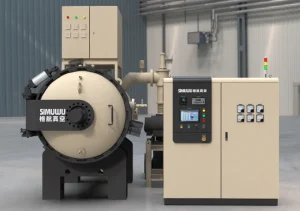
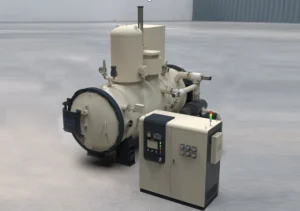
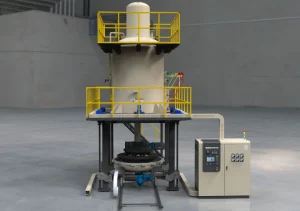
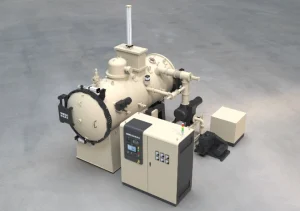
Achieving precise thermal uniformity control remains a critical challenge in vacuum heat treatment, where radiation is the primary mode of heat transfer. Multi-zone heating uniformity is a design and control approach that minimizes temperature gradients by dividing a vacuum furnace into independently controlled heating sections. This article explores the technical mechanisms, design principles, and control strategies that allow multi-zone architecture to eliminate temperature fluctuations and ensure consistent metallurgical properties.
1. The Fundamentals of Multi-zone Heating Architecture
The core concept of multi-zone heating is to segment the furnace chamber into thermal control volumes, each with independent sensing and actuation. In a standard vacuum resistance furnace, heat transfer relies almost exclusively on radiation, following the Stefan-Boltzmann law.
Because radiant intensity decreases with distance and varies based on “view factors,” a single-zone control source often fails to maintain a uniform temperature field in a large volume. By utilizing multiple zones—typically arranged axially or circumferentially—the system matches local heat input to local heat loss. This modular approach allows for highly granular adjustment, which is the foundation of vacuum furnace temperature uniformity.
2. Design Principles: Compensating for Heat Loss and Load
Thermal gradients often occur at the edges of the hot zone due to conduction through support structures and radiation leakage toward the furnace shell.
- Active Compensation: Multi-zone systems “over-power” the areas near the door or rear to maintain a flat temperature profile.
- Load Density Management: Dense parts in the center of a batch may be shielded from radiation. Multi-zone control provides extra energy to these concentrated areas, preventing “cold spots.”
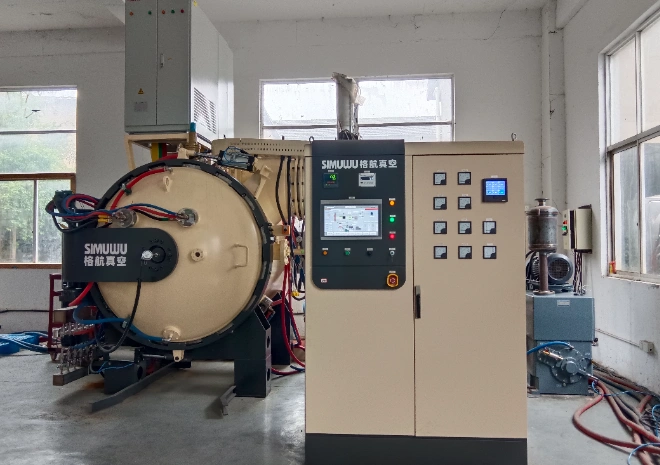
- Zoning Strategy: Zone sizing must be proportional to expected gradients. For instance, a Vacuum Gas Quenching Furnace may require 3 to 6 zones to handle the rapid thermal shifts during processing.
3. Key Components and Advanced Control Logic
The effectiveness of a zoned heating vacuum furnace relies on the integration of high-quality components and sophisticated algorithms:
- Sensors and PID Integration: Each zone is equipped with a dedicated thermocouple and power controller (SCR or thyristor). Advanced systems use PID (Proportional-Integral-Derivative) loops or Model Predictive Control (MPC) to prevent “hunting”—where zones fight each other’s thermal output.
- Lead-Lag Logic: During the heating phase, outer zones may “lead” to pull the center load up to temperature faster, tightening to within ±3°C as the setpoint is approached.
- Thermal Isolation: Internal baffles are often used to limit “cross-talk” or radiative exchange between adjacent zones.
4. Meeting Industry Standards (AMS2750F & NADCAP)
Adherence to global standards like AMS2750F requires rigorous Temperature Uniformity Surveys (TUS). These standards define furnace classes based on the degree of thermal uniformity control:
- Class 1: ±3°C (±5°F)
- Class 2: ±6°C (±10°F)
Multi-zone heating is often the only viable way to meet Class 1 requirements in large-scale industrial furnaces. If a TUS reveals a deviation, the multi-zone controller can be calibrated to offset that specific zone’s power, a feat impossible in single-zone configurations.
5. Impact on Specific Vacuum Processes
The benefits of multi-zone temperature control extend across various specialized thermal applications:
- Vacuum Brazing: Even a 5°C variance can cause joint failure. Precise zoning ensures complete wetting.
- Vacuum Carburizing: Ensures consistent carbon diffusion depth across the entire batch.
- Vacuum Annealing: Prevents localized grain growth, ensuring uniform mechanical properties.
- Vacuum Sintering: Critical for maintaining dimensional stability in complex alloy parts.
6. FAQ: Common Questions on Multi-zone Systems
Q: Does multi-zone heating increase energy consumption?
A: Paradoxically, it often improves efficiency. By targeting power precisely and reducing the “soak time” needed for cold spots to catch up, the total energy per cycle is frequently lower.
Q: Can a single-zone furnace be upgraded?
A: While technically complex—requiring new power feedthroughs, additional thermocouples, and PLC upgrades—it is possible and often necessary to meet modern quality standards.
Q: How many zones are typically required?
A: Small lab furnaces may use 1–2 zones, while large production units typically require 3–6 zones to maintain high-level uniformity.
Conclusion
Superior thermal uniformity control is the cornerstone of high-quality vacuum heat treatment. By implementing multi-zone heating uniformity strategies, manufacturers guarantee compliance with the strictest aerospace and medical standards while optimizing cycle times.
For guidance on selecting the right system, see our guide on How to Select the Best Vacuum Furnace Systems for Your Factory. Contact us today to discuss your specific thermal uniformity requirements.
-
Vacuum vs Atmospheric Furnace Environment Comparison
2026-03-27
-
Double Chamber Vacuum Oil Quenching Furnace with Gas Quenching Function
2026-03-26
-
Precision Vacuum Furnace Gas Flow Control Systems
2026-03-25
-
Introduction to the Vacuum Oil Quenching Carburizing Process
2026-03-24
-
Precise Methods to Measure the Wetting Angle of Metals Under Vacuum
2026-03-23