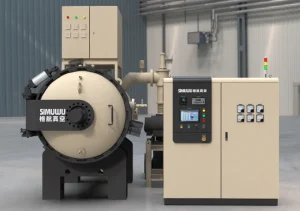
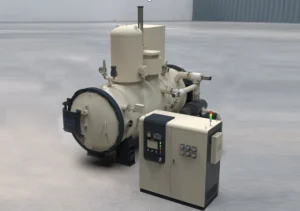
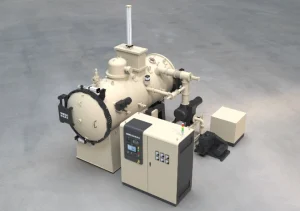
The final price of a vacuum furnace is not a single fixed number; it is a calculation driven by technical specifications, engineering complexity, and the intended manufacturing application. Understanding how much does a vacuum furnace cost requires a deep dive into the technical pillars that dictate industrial pricing—from temperature capability and vacuum levels to the specific furnace solution required for your production line.
1. The Primary Cost Drivers: Temperature and Materials
Operating temperature is the most significant factor in the industrial vacuum furnace cost.
- Graphite Systems (Up to 1300°C): Most standard quenching and annealing processes use graphite heating elements and felt insulation. These are cost-effective and durable.
- Refractory Metal Systems (1300°C – 2000°C+): If your process, such as a Vacuum Hydrogen Furnace application, requires ultra-high purity or temperatures exceeding 1600°C, the furnace must utilize molybdenum or tungsten. These metals are significantly more expensive than graphite, often doubling the heating chamber cost.
2. Vacuum Levels and Pumping Groups
The cost scales with the required “ultimate vacuum” pressure.
- Rough/Medium Vacuum: A standard setup with a mechanical pump and Roots pump is sufficient for general hardening.
- High Vacuum (10⁻⁵ Torr or better): To achieve the high-purity environment required for a High Temperature Vacuum Brazing Furnace, the addition of oil diffusion pumps or turbomolecular pumps is mandatory. This adds technical complexity, specialized valving, and high-quality vacuum sensors, increasing the investment.
3. Chamber Volume and Orientation: The Large Vacuum Furnace
The physical size and orientation of the equipment create a significant price delta:
- Horizontal Furnaces: The industry standard for most batch processing; generally offers the best ROI for small to medium loads.
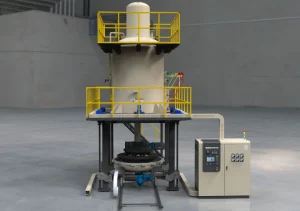
- Vertical Type Furnaces: A large vacuum furnace in a vertical configuration (bottom-loading or top-loading) involves complex heavy-duty lifting mechanisms and specialized pit construction. While the equipment cost is higher, it is often the only manufacturing solution for tall, heavy, or delicate aerospace components that require minimal distortion.
4. What is the Cost of a Vacuum Brazing Furnace?
Brazing furnaces typically cost 20% to 40% more than standard annealing furnaces of the same size. This premium is due to:
- 1. Stricter Temperature Uniformity: Brazing requires precision (typically ±5°C or better) to ensure the filler metal flows correctly without damaging the base metal.
- 2. Higher Vacuum Requirements: To prevent oxidation of the joints, high-vacuum pumping groups are standard.
- 3. Contamination Management: Specialized traps are often needed to protect pumps from volatile metal vapors.
5. Custom Manufacturing Solution vs. Standard Furnace Solution
Choosing a standard furnace solution can save on initial capital expenditure. However, a tailored manufacturing solution is often required for unique applications, such as:
- Dual-Chamber Designs: Integrating oil and gas quenching in one system.
- Multi-Zone Heating: Achieving superior thermal uniformity for oversized components.
- Automation Integration: Connecting the furnace to a factory-wide PLC or SCADA system for Industry 4.0 compliance.
6. Total Cost of Ownership (TCO)
Beyond the initial purchase price, a professional ROI analysis must include:
-
- Utility Consumption: High-efficiency insulation and smart gas management can reduce long-term electricity and nitrogen/argon costs.
- Maintenance: Graphite elements are cheaper to replace than molybdenum.
- Lifespan: A high-quality industrial furnace is a 20-year investment; cheap components often lead to costly unscheduled downtime.
Related Reading:
Why Work with Trusted Vacuum Furnaces Manufacturers for Industrial Applications?
7. FAQ
Q: What is the typical price range for an industrial vacuum furnace?
A: Depending on specs, a small lab-scale unit may start around $50,000 to $80,000. A complex, large vacuum furnace for mass production can exceed $500,000 to $1,000,000+.
Q: Does a vertical furnace cost more than a horizontal one?
A: Yes. The complexity of the loading mechanism and the engineering required for the pressure vessel’s vertical movement increase both the equipment price and installation costs.
Q: Why should I invest in a custom furnace solution?
A: While the upfront cost is higher, a custom solution maximizes throughput and ensures your specific metallurgical requirements are met, leading to lower per-part costs in the long run.
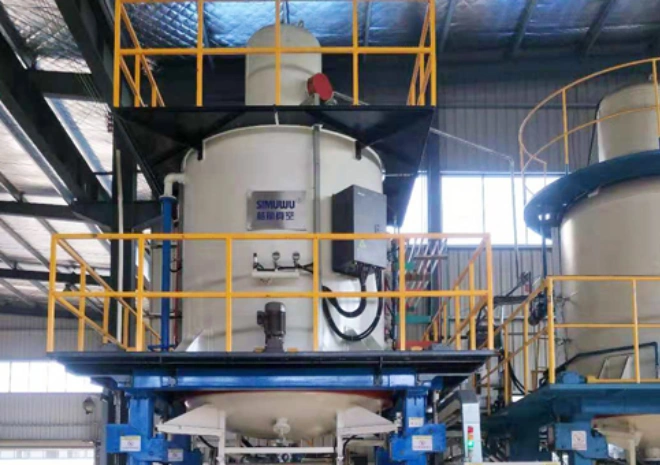
Selecting the right furnace requires balancing technical performance with long-term financial viability. At SIMUWU, we provide comprehensive furnace solutions ranging from standard batch furnaces to high-precision brazing systems. Contact our engineering team today for a detailed quote and a custom manufacturing solution tailored to your production goals.
-
SIMUWU Up-and-Down Air-Blowing Structure Furnace: Meeting Rigorous Heat Treatment Requirements
2026-03-10
-
How Advanced Vacuum Control Systems Reduce Vacuum Furnace Energy Consumption
2026-03-09
-
Vacuum vs. Conventional Heat Treatment Comparison
2026-03-06
-
Brief Description of Vacuum Quenching Process for H13 Aluminum Extrusion Dies
2026-03-05
-
The Difference Between Solution and Anneal in Heat Treatment
2026-03-04