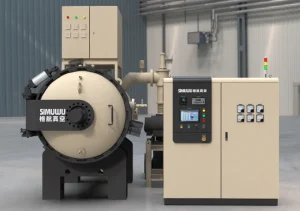
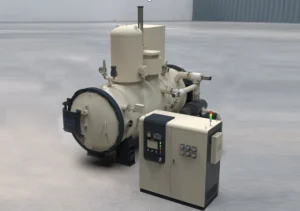
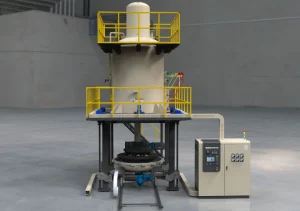
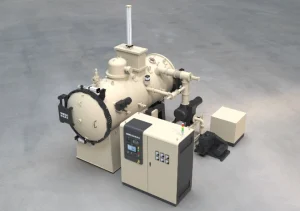
In advanced vacuum metallurgy, the precision of gas delivery systems determines the consistency of finished products and the repeatability of complex thermochemical cycles. The ongoing transition from analog to digital mass flow controllers (MFCs) represents a significant shift in how engineers manage atmosphere-sensitive processes. This comparative analysis explores the technical architectures of both systems and their critical impact on optimizing vacuum furnace operations.
1. Fundamental Differences in Signal Processing
Mass flow controllers in metallurgical applications differ primarily in their internal signal processing and control methodology. Analog MFCs utilize continuous electrical signals, typically 4-20 mA or 0-10 V, relying on hardware-based circuitry to interpret flow rates and adjust valves. This design offers simplicity and compatibility with legacy Programmable Logic Controllers (PLCs), but it is inherently susceptible to electrical noise over long cabling, leading to potential signal drift.
Digital MFCs, conversely, employ microprocessor-based control and Digital Signal Processing (DSP). By utilizing communication protocols such as Fieldbus, Profibus, or Ethernet/IP, these devices transmit discrete data packets. This digital architecture eliminates the errors associated with signal conversion and allows for advanced control algorithms that are physically impossible to implement with fixed analog hardware.
2. Performance Metrics: Accuracy and Response Time
Accuracy and response time are the most critical performance metrics when evaluating digital vs. analog mass flow controllers. Analog systems generally provide reliable flow control for steady-state processes, but their response time can be hindered by the inherent lag of analog components.
Furthermore, they are more sensitive to ambient temperature fluctuations and pressure changes, which can introduce subtle inaccuracies in gas metering.
Digital MFCs offer superior accuracy—often within ±1% of the setpoint—and significantly faster response times. This rapid adjustment is vital in processes where the atmosphere must be corrected before the metal reaches a reactive temperature. Because digital units compensate for temperature and pressure internally, they maintain high precision throughout the entire vacuum cycle, even during the transition between viscous and molecular flow.
3. Multi-Gas Calibration and Flexibility
A significant advantage of digital technology is the ability to handle multi-gas calibrations within a single device. Traditional analog MFCs are typically calibrated for one specific gas and require manual re-adjustment or hardware modification to switch gas types. This limits operational flexibility in multi-purpose heat treatment facilities.
Digital MFCs feature software-programmable gas profiles. An operator can switch between nitrogen, argon, or hydrogen by selecting a pre-loaded gas correction factor in the controller’s memory. This capability ensures that the thermal properties of each gas are correctly accounted for, maintaining the precise mass flow measurement required for high-standard vacuum applications.
4. Integration and Diagnostic Capabilities
The integration of digital MFCs into automated production lines provides a level of transparency that analog systems cannot match. Analog controllers provide basic flow feedback but offer no insight into the “health” of the device. If a valve sticks or a sensor fails, the issue may only be discovered through a failed metallurgical batch.
Digital controllers provide real-time self-diagnostics and status information. They can record flow trends, monitor valve drive levels, and alert operators to maintenance needs before a failure occurs.
5. Application in Critical Vacuum Processes
In precision metallurgy, the choice of controller directly impacts the chemical potential at the material surface. For example, in a Vacuum Carburizing Furnace, the high-speed switching and accurate volume delivery of digital MFCs are required for successful pulse-injection of hydrocarbons. This ensures a uniform case depth across complex geometries.
Similarly, in a Vacuum Nitriding Furnace, maintaining a precise ammonia-to-hydrogen ratio is vital for controlling the compound layer thickness. The stability provided by digital control prevents the fluctuations that lead to “white layer” inconsistencies, which are critical for parts requiring high wear resistance.
6. Selection Framework: Cost vs. Technical Requirement
The final decision between digital vs. analog mass flow controllers depends on the specific project requirements and budget constraints. Analog controllers remain a cost-effective solution for non-critical, high-volume production where advanced data logging and extreme precision are not required. Their simplicity makes them ideal for straightforward atmosphere management in legacy systems.
However, for facilities aiming for aerospace or medical-grade standards, the long-term value of digital MFCs—through reduced batch failure, faster cycle times, and simplified calibration—outweighs the higher upfront cost.
7. FAQ
What is the primary difference between analog and digital MFCs?
The primary difference is the signal processing: analog uses continuous electrical signals (4-20mA), while digital uses microprocessor-based data transmission for higher accuracy and diagnostics.
Can I upgrade my existing furnace from analog to digital MFCs?
Yes, many digital MFCs are available with “analog-compatible” modes, allowing them to drop into existing 4-20 mA loops while providing superior internal digital processing.
Do digital MFCs require more frequent calibration?
No, digital MFCs often require less frequent calibration because they do not suffer from analog component drift and can internally compensate for environmental changes.
Why is response time important in vacuum quenching?
In Vacuum Gas Quenching Furnace operations, delayed gas delivery can lead to uneven cooling or surface oxidation. A fast response ensures the atmosphere is corrected instantly.
Are digital MFCs better for multi-gas applications?
Yes, digital MFCs can store multiple gas profiles, allowing the same device to be used for nitrogen, argon, or hydrogen without hardware changes.
Selecting the appropriate mass flow controller is a critical step in achieving superior metallurgical results. Whether you prioritize the simplicity of analog systems or the advanced precision of digital control, matching the technology to your process needs is essential for operational efficiency.
-
4140 Vacuum Oil Quenching Process
2026-04-08
-
Vacuum Brazing Joint Quality: Dynamics & Design
2026-04-03
-
Important Applications of Low-Temperature Vacuum Aluminum Brazing Furnace
2026-04-02
-
The Role of Partial Pressure Control in High-Temperature Vacuum Sintering
2026-04-01
-
40Cr Vacuum Oil Quenching Process
2026-03-31